


 Sep 24, 2025
 Page Views:2086


Beware of the “Atopic March”: From Skin to Systemic Disease
September 14, 2025, marks the 8th World Atopic Dermatitis Day. Atopic dermatitis (AD) is a common, chronic, and relapsing inflammatory skin disease characterized by intense pruritus and eczematous lesions. As the initial step of the “atopic march,” AD is associated with core pathological changes, including impaired skin barrier function, immune dysregulation, and microbiome imbalance. Research shows that approximately 30–50% of patients with moderate-to-severe AD will progress to other atopic diseases such as allergic rhinitis (AR) and allergic asthma (AA), forming the typical “atopic march.”

AD and the Atopic March
The “atopic march” refers to the age-related progression of allergic diseases, manifesting as the sequential onset of atopic disorders affecting different organ systems, driven by evolving allergen sensitization. AD is often the first manifestation, followed by IgE-mediated food allergy (FA), AR, and AA, with increasing sensitivity to food and/or environmental allergens. The prevalence of AD in children ranges from 17% to 24%. Among them, 48% develop symptoms before 6 months of age, and 89% before the age of 5, with incidence peaking around age 2. While about half of affected children experience remission by adolescence, the other half continue into adulthood. The severity of AD strongly correlates with an increased risk of subsequent FA, AR, and AA.
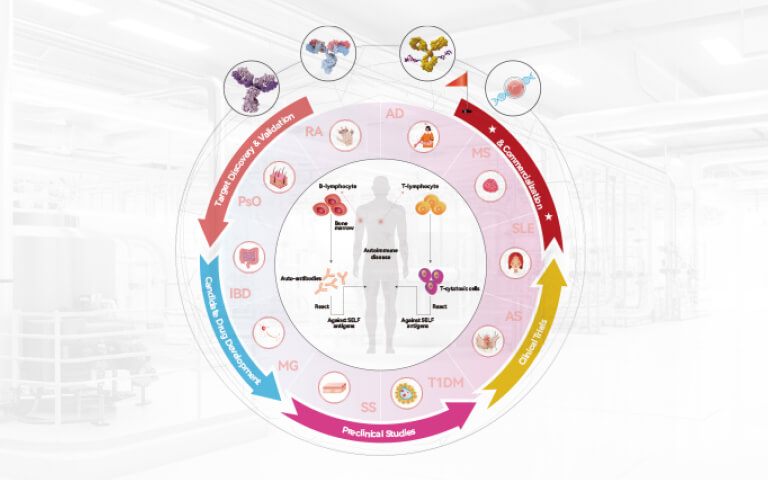
ACROBiosystems has developed a comprehensive product portfolio for AD research including highly active recombinant proteins, recombinant proteins, stable cell lines, and inhibitor screening kits.Our solutions span the entire drug development continuum – from target discovery and validation, candidate drug screening and development to CMC manufacturing and quality control – accelerating the efficient translation of AD innovative therapies from foundational research to clinical implementation.

Free download: ACRO's autoimmune disease drug development solutions!
Why Does AD Act as the Initiator of the “Atopic March”?
The pathogenesis of AD follows a distinct stepwise progression. It often begins in areas of skin that appear clinically normal but already exhibit significant barrier dysfunction, allowing environmental allergens to penetrate the epidermis. These antigens are captured and presented by epidermal Langerhans cells (LCs) and dermal dendritic cells (DCs), triggering an initial immune response that recruits and activates inflammatory cells locally. Barrier disruption also stimulates keratinocytes to release epithelial “alarmins” such as TSLP and IL-33, along with chemokines like CCL17. These mediators not only amplify itch signaling but also activate type 2 innate lymphoid cells (ILC2s) and Th2 cells, establishing an early immune environment dominated by type 2 inflammation.

Mechanistic Insights into AD
In the acute phase of AD, Th2 cells secrete IL-4 and IL-13, which drive IgE class switching, suppress the expression of key barrier proteins, and recruit eosinophils and other inflammatory cells—thereby amplifying inflammation and increasing susceptibility to infection. As the disease progresses to the chronic phase, the immune response shifts to a mixed Th1/Th2 profile, with further dysregulated expression of cytokines such as IL-17, IL-22, and IL-23. This fosters a self-perpetuating cycle of chronic inflammation, structural remodeling of the skin, and persistent pruritus. This multi-stage, multi-pathway, and multi-target immune dysregulation explains why AD serves as a critical initiating factor in the atopic march, predisposing patients to subsequent allergic diseases.
Targeted Breakthroughs: A New Era in AD Therapy
In recent years, biologics and small-molecule targeted therapies have driven a new wave of innovation in AD treatment, with several agents already approved and achieving impressive market performance. Dupilumab, the first fully human monoclonal antibody targeting IL-4Rα, has dominated the global AD market since its 2017 approval, generating more than $14.2 billion in sales in 2024 alone. Tezepelumab, the first monoclonal antibody against TSLP, was initially approved for asthma but is being closely watched for its potential expansion into AD, with substantial commercial prospects. Tralokinumab, the first monoclonal antibody specifically targeting IL-13, has also been approved for moderate-to-severe AD. Meanwhile, earlier-approved cytokine inhibitors such as Secukinumab (IL-17A) and Ustekinumab (IL-12/IL-23), while not frontline AD therapies, have demonstrated strong efficacy in psoriasis and other immune-mediated diseases, providing important reference points for their potential use in AD.
Approved and Phase III Biologics for AD (Data Source: Pharmacodia)

At the Phase III stage, a wave of promising therapies is advancing toward market, with competition centering on high-value targets such as IL-4Rα, TSLP, and OX40/OX40L. Stapokibart (Consino Biologics) became the first to gain approval in China in September 2024, supported by strong international Phase III data positioning it as a potential challenger to Dupilumab’s dominance. Another IL-4Rα-targeting candidate, Rademikibart (Connect Biopharma), has already filed for regulatory approval. On the OX40 pathway, Rocatinlimab (Amgen, anti-OX40) and Amlitelimab (Sanofi, anti-OX40L) have both demonstrated durable disease control in Phase II trials, raising expectations for the next major breakthrough in AD treatment.
ACROBiosystems Pioneers AD Therapeutics with Innovative Solutions
ACROBiosystems has developed a comprehensive product portfolio for AD research including highly active recombinant proteins,recombinant proteins, stable cell lines, and inhibitor screening kits. Our solutions span the entire drug development continuum – from target discovery and validation, candidate drug screening and development to CMC manufacturing and quality control – accelerating the efficient translation of AD innovative therapies from foundational research to clinical implementation.
Free download: ACRO's autoimmune disease drug development solutions!
Hot AD Target Recommendations
Related Articles
>>World Ankylosing Spondylitis Day | ACRO Stands with You in Safeguarding Spinal Health
>>World Lupus Day | ACRO Stands with You in the Fight Against SLE
>>World Inflammatory Bowel Disease Day | ACRO Stands with You in Safeguarding Intestinal Health
>>World Myasthenia Gravis Day | ACRO Stands with You in Protecting Muscle Health
>>World Sjögren’s Day | Advancing Together with ACRO to Uncover the Truth Behind Dryness

>> ComboX, A Combination of Universal Solutions
References
1. Pareek A, Kumari L, Pareek A, et al. Unraveling atopic dermatitis: insights into pathophysiology, therapeutic advances, and future perspectives[J]. Cells, 2024, 13(5): 425.
2. Schuler IV C F, Tsoi L C, Billi A C, et al. Genetic and immunological pathogenesis of atopic dermatitis[J]. Journal of Investigative Dermatology, 2024, 144(5): 954-968.
3. Bieber T, Paller A S, Kabashima K, et al. Atopic dermatitis: pathomechanisms and lessons learned from novel systemic therapeutic options[J]. Journal of the European Academy of Dermatology and Venereology, 2022, 36(9): 1432-1449.
4. Tsuge M, Ikeda M, Matsumoto N, et al. Current insights into atopic march[J]. Children, 2021, 8(11): 1067.