



Quality Advantages
"Structurally defined, high-quality protein products help reduce uncertainty and lower risk at every stage of drug discovery and development.”
John Miao
Vice Chairman of ACROBiosystems Group
Research-use only Grade Products
ACROBiosystems, with its extensive experience in the development of target proteins, has summarized several key points of target proteins for drug development.
The key points above mainly cover elements in five aspects:
Purity and Homogeneity
Purity testing methods commonly used by ACROBiosystems include SDS-PAGE, HPLC, and MALS.
SDS-polyacrylamide gel electrophoresis (SDS-PAGE), is an analytical detection technique of proteins. It is mostly used to determine the proportion and content of target and miscellaneous proteins. However, since the proteins are denatured before analysis, it is hard to monitor the aggregation of proteins in solution.
MALS validation of purity is a key advantage of ACROBiosystems,which ensures correct protein structure, controllable protein aggregation state, homogeneity and batch-to-batch consistency. This is also the basis for consistent results of ELISA, SPR, and BLI activity validation. Therefore, we know that customers invested in biopharmaceutical development understand that the aggregation state and batch variation of proteins used are critical.
ACROBiosystems is committed to helping customers minimize the risks of drug research and development, ensuring purity levels for customers, and providing customers with high-quality recombinant proteins that are homogenous, consistent between batches, and more importantly, have the correct structure.
Confirming that the target protein is as close as possible to its natural conformation
As protein structure is the basis for functional activity, only proteins that are close to its natural conformation can properly perform and mimic its biological functions. In particular, the natural aggregation of proteins and correct formation of disulfide bonds are critical in maintaining the correct structure of proteins, and should be the main focus when developing of target proteins. ACROBiosystems selects HEK293 as the expression system of host cells, since proteins expressed by HEK293 system are better modified, including glycosylation modification, therefore closely resembling the natural conformation within human body. This cannot be achieved by other prokaryotic expression system or non-human eukaryotic system. As a critical raw material of antibody drug development, the high-quality target protein with natural conformation and correct structure can significantly increase the success rate of antibody drug development and reduce the uncertainty of drug development in critical application scenarios, such as antibodies acquisition by immunization, screening of functional antibodies and clinical validation of antibody effectiveness.
Activity and performance are validated in its target application scenarios
In the process of developing a target protein, it can be frequently observed that the same protein product performs completely differently under a real application scenarios. Therefore, it is necessary to establish the goals before the start of R&D and clarify the target application scenarios of the protein.
ACROBiosystems tests our protein under the target application scenario during the development process evaluates the protein performance under a simulated application scenario.
Batch-to-batch consistency of products
ACROBiosystems products have high batch-to-batch consistency, which requires strict control of the protein manufacturing process under a well-established quality system. This ensures a high degree of consistency between product batches.
Abilities to manufacture and continuously develop products
We maintain our protein products so they can be consistently produced over time, continuing consistent quality and supporting long-term demand for proteins within the development process and throughout the life cycle of biopharmaceuticals. ACROBiosystems has over 200 professionals working in product R&D to ensure that the capability of new product development is fully guaranteed.
GMP-Grade Products
ACROBiosystems interprets the relevant domestic and international regulatory requirements in depth, and formulates solutions for critical reagent-related problems that may be encountered in the development of cell therapy drugs.
ACROBiosystems has summarized key features in the selection of GMP-grade raw materials for cell therapy based on domestic and international regulations and customer requirements to guide the development, manufacturing and quality control of products.
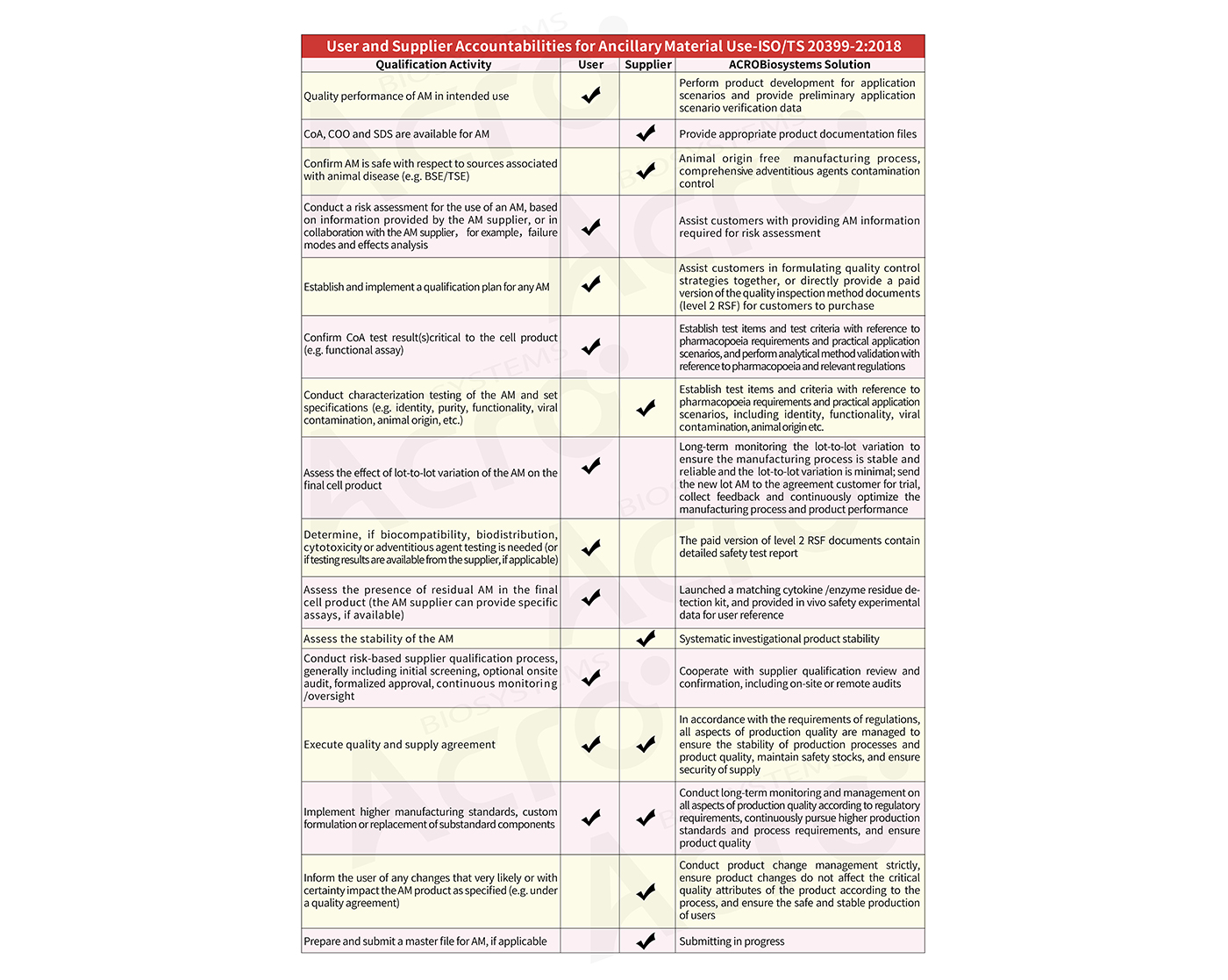
Production qualification of suppliers
● Suppliers should pass ISO quality system certification and have an effective quality management system.
● Hardware facilities such as production workshops should strictly meet the requirements of GMP regulations and provide necessary documentation such as providing audit certificates from third-party authorities, such as drug production license, GMP audit reports from well-known third-party organizations, other qualification documents, etc.
● The suppliers should have advanced R&D and production technology, qualified manufacturing process and capabilities, and the capacity for continuous production and supply.
Product quality and performance
● Comprehensive analysis and characterization is performed, including identification, content, purity, biological activity, moisture, process-related impurities, potential contaminants, etc.
● The products are fully validated in practical application scenarios, and their performance can meet the application requirements (such as T cell culture and activation experiments).
● Each analytical procedure is systemically validated and traced, which is accurate, reliable and repeatable. Procedures can also be used for accurate analysis and verification of the product quality, along with long-term monitoring of the batch differences of manufacturing.
● The integrity of analytical data meets all regulatory requirements.
Batch-to-batch consistency and stability
● Production raw materials, plant equipment, laboratory analysis and testing, product packaging and storage meet the regulatory requirements of GMP quality management system and cell therapy raw materials.
● The key production parameters are strictly controlled, and the production process is stable and reliable.
● The batch differences of production are continuously monitored and analyzed, and OOS deviation analysis is performed.
● Product stability is fully evaluated to ensure stable and reliable performance during transportation, storage and use.
Product safety
● Our products undergo testing including sterility, bacterial endotoxin, virus, mycoplasma, related impurity content (HCP, DNA, antibiotics), final product residues, other miscellanies (foreign matter, additives, etc.)
Comprehensive Regulatory support documentation
● We provide a comprehensive set of documentation on safety, including proof of origin, Certificate of Analysis (COA), outsourced test report and related qualification certification, packing instructions, TSE/BSE-free statement, animal origin-free (AOF) statement, DMF documents, RSF regulatory support documents, etc.
If a Supplier Survey or Quality Statement is required, please click the buttoncontact us.