

IL-2 and IL-2 Receptor Proteins

Interleukin-2 (IL-2) is a pluripotent cytokine which plays a crucial role in the immune system response. And the IL-2 receptor (IL-2R) is a heterotrimeric protein expressed on the surface of certain immune cells, such as lymphocytes, that binds and responds to IL-2.
IL-2R consists of three subunits, namely IL-2Rα (CD25), IL-2Rβ (CD122), and common γc (CD132). The three receptor chains are expressed separately and differently on various cell types and can assemble in different combinations and orders to generate low, intermediate, and high affinity IL-2 receptors.
Many biopharma and biotech companies have carried out different IL-2 modification and design, including PEG modification, fusion Fc, IL-2 mutant design, bispecific antibody design, and combined immunization checkpoint antibody drug therapy and other strategies.
Therefore, a series of structurally stable and high-affinity IL-2 receptor heterodimers and heterotrimers are of great significance for in vitro studies of the interaction between IL-2 and IL-2 receptors, and also for the antibody immunization and screening.
Native IL-2 has pleiotropic effects on the immune response

Fig.1 Native IL-2 has pleiotropic effects on the immune response[1]

Schematic of IL-2 binding to the low-affinity, intermediate-affinity and high-affinity IL-2 receptors

Fig 2. Schematic of IL-2 binding to the low-affinity, intermediate-affinity and high-affinity IL-2 receptors. The high-affinity receptor comprises IL-2 receptor α-chain (IL-2Rα), IL-2Rβ and IL-2Rγ.[2]

ACROBiosystems has developed a series of IL-2 related proteins: IL-2, IL-2Rα, IL-2Rβ, IL-2Rγ, IL-2R βγ heterodimer, and IL-2Rαβγ heterotrimer with high purity, high stability and high bioactivity, which can be used to research the interaction between IL-2 and IL-2 receptors, immunization, antibody screening, etc., to facilitate the development of IL-2 related drugs. In addition, we can also provide GMP-grade IL-2 used for scale-up culturing of various cell types such as T/NK cells and iPSCs.

Product list

IL-2
IL-2Rα
IL-2Rβ
IL-2Rγ
IL-2Rβγ
IL-2Rαβγ

Assay data

Affinity Verified by SPR
The affinity verification results of IL-2 with IL-2 receptor by SPR are basically consistent with the literature[4]

Table 1 Affinity Data of IL-2 Binding to IL-2 Receptor

IL-2 R

IL-2 R αβγ

IL-2 R βγ

IL-2 R alpha

IL-2 R beta

Affinity to Human IL-2

40.6 pM

0.279 nM

29.9 nM

377 nM

Affinity verification data of IL-2 binding to IL-2 receptor protein (SPR)

Human IL-2RB&IL-2RA&IL-2RG, Fc Tag&Fc Tag (Cat. No. ILG-H5257) captured on CM5 chip via Anti-human IgG Fc antibodies surface can bind Human IL-2, Tag Free with an affinity constant of 40.6 pM as determined in a SPR assay (Biacore 8K) (Routinely tested).

Request Protocol

Affinity verification data of IL-2 binding to IL-2 receptor protein (SPR)

Human IL-2RB&IL-2RG Heterodimer Protein, Fc Tag&Fc Tag (Cat. No. ILG-H5254) captured on CM5 chip via Anti-human IgG Fc antibodies surface can bind Human IL-2, Tag Free with an affinity constant of 0.279 nM as determined in a SPR assay (Biacore 8K) (Routinely tested).

Request Protocol

Affinity verification data of IL-2 binding to IL-2 receptor protein (SPR)

Human IL-2 R alpha, His Tag (Cat. No. ILA-H52H9) captured on CM5 chip via anti-His antibody, can bind Human IL-2, Tag Free with an affinity constant of 29.9 nM as determined in a SPR assay (Biacore T200) (Routinely tested).

Request Protocol

Affinity verification data of IL-2 binding to IL-2 receptor protein (SPR)

Cynomolgus IL-2 R beta, His Tag (Cat. No. ILB-C52H9) immobilized on CM5 Chip can bind Cynomolgus IL-2, His Tag (Cat. No. IL2-C5249) with an affinity constant of 377 nM as determined in a SPR assay (Biacore 8K) (Routinely tested).

Request Protocol

Heterogeneity Verified by MALS
MALS verification of IL-2RB&IL-2RG heterodimer protein

The purity of Human IL-2RB&IL-2RG Heterodimer Protein, Fc Tag&Fc Tag (MALS verified)(Cat. No. ILG-H5254) is more than 90% and the molecular weight of this protein is around 145-165 kDa verified by SEC-MALS.

MALS verification of IL-2RB&IL-2RA&IL-2RG heterotrimer protein

The purity of Human IL-2RB&IL-2RA&IL-2RG, Fc Tag&Fc Tag(Cat. No. ILG-H5257) is more than 90% and the molecular weight of this protein is around 175-190 kDa verified by SEC-MALS.
Bioactivity Verified by ELISA
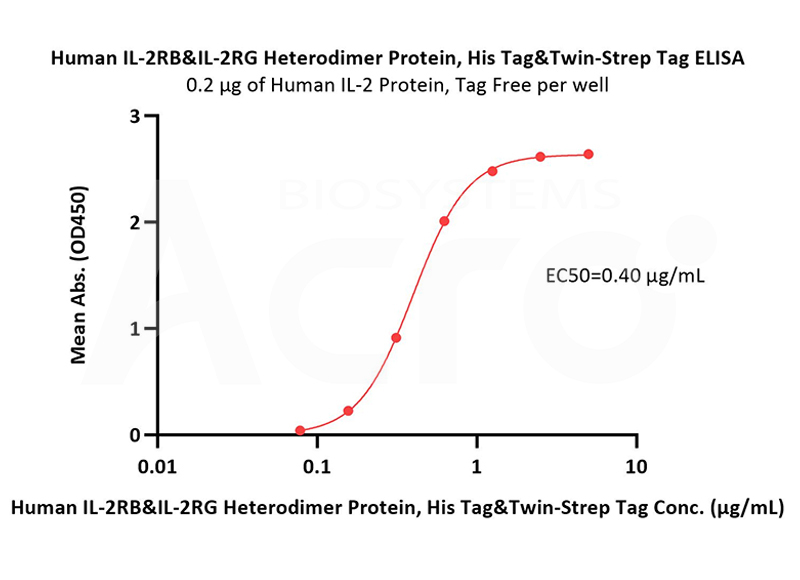
Verification data of IL-2 binding to IL-2 receptor protein (ELISA)

Immobilized Human IL-2 Protein, Tag Free (Cat. No. IL2-H5215) at 2 μg/mL (100 μL/well) can bind Human IL-2RB&IL-2RG Heterodimer Protein, His Tag&Twin-Strep Tag (Cat. No. ILG-H5283) with a linear range of 0.078-0.625 μg/mL (QC tested).

Request Protocol
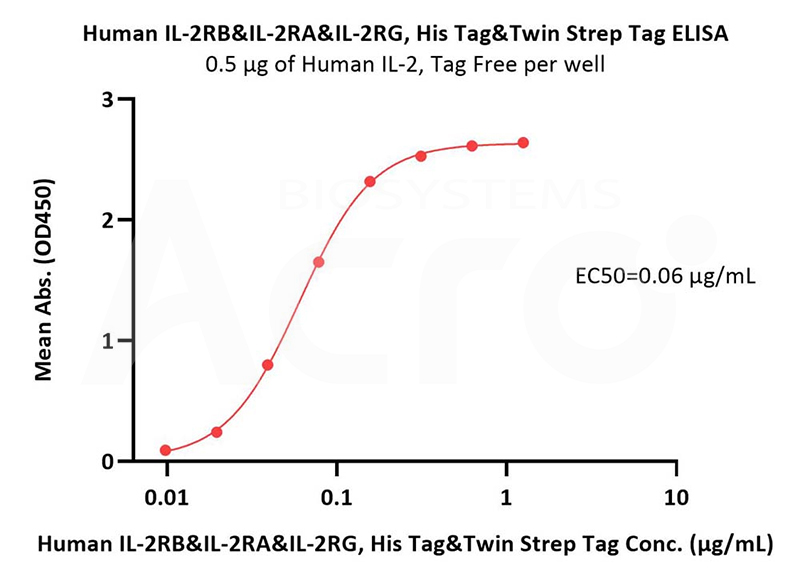
Verification data of IL-2 binding to IL-2 receptor protein (ELISA)

Immobilized Human IL-2, Tag Free at 5 μg/mL (100 μL/well) can bind Human IL-2RB&IL-2RA&IL-2RG, His Tag&Twin Strep Tag (Cat. No. ILG-H52W9 ) with a linear range of 0.01-0.313 μg/mL (QC tested).

Request Protocol

References

1. NKTR-2017JPMorganSlides

2. Spolski R, et al. Nat Rev Immunol. 2018. PMID: 30089912 Review.

3. Xinquan Wang et al.,2005, Science. 310(5751):1159-63.

4. Balasubramanian, S. Int Immunol. 1995 Nov;7(11):1839-49.

FAQ

Q

Why should IL-2 and engineered IL-2 molecules be evaluated against IL-2Rα, IL-2Rβγ, and IL-2Rαβγ?

IL-2Rα/CD25 alone, IL-2Rβγ, and IL-2Rαβγ represent receptor configurations with markedly different IL-2-binding properties. Testing only one receptor form can therefore obscure whether a candidate is CD25-dependent, βγ-biased, or capable of engaging the high-affinity trimeric receptor. Parallel testing of the three formats provides a clearer receptor-selectivity profile for IL-2 muteins, fusion proteins, immunocytokines, and blocking antibodies before functional studies.
Q

How does CD25 versus IL-2Rβγ binding bias influence immune-cell selectivity and therapeutic potential?

CD25 is highly expressed on regulatory T cells and activated T cells, whereas IL-2Rβγ is also important on effector T cells and NK cells. Engineering reduced CD25 binding or enhanced βγ engagement can therefore shift cellular activity, but receptor affinity alone does not fully predict in vivo selectivity. Candidate evaluation should compare receptor-complex binding with pSTAT5, proliferation, and relevant immune-cell responses to determine whether the intended functional bias is achieved.
Q

Which quality attributes are most important when qualifying IL-2 receptor heterodimers and heterotrimers?

The most important risks are free subunits, incorrectly assembled complexes, aggregates, and loss of IL-2-binding activity. These species can distort apparent affinity and candidate ranking even when SDS-PAGE purity appears acceptable. Complex qualification should therefore combine purity testing with molecular-weight and homogeneity analysis, such as SEC-MALS for selected products, and direct IL-2 binding by SPR, BLI, or ELISA.
Q

Why must IL-2 receptor-binding selectivity be confirmed in cell-based signaling assays?

A candidate may show preferential binding to IL-2Rβγ or IL-2Rαβγ without producing the expected cellular response. Receptor density, assembly on the cell surface, internalization, and signaling kinetics can all alter functional potency. Binding data should therefore be followed by pathway-relevant assays such as pSTAT5 activation, proliferation, cytokine release, or immune-cell subset analysis. This distinction is particularly important for receptor-biased IL-2 muteins and immunocytokines.
Q

Why are human and preclinical-species IL-2 pathway proteins needed during drug development?

Engineered IL-2 molecules and receptor-directed antibodies can differ substantially in affinity across species. Early comparison of human and relevant preclinical-species IL-2, receptor subunits, and receptor complexes helps assess cross-reactivity and select pharmacology or safety models. Protein-binding data are useful for triage, but model selection should also incorporate cell-based signaling and in vivo activity because receptor expression and immune-cell biology differ between species.
  • Background
  • Features
  • Product list
  • More IL series products
  • Assay data
  • References
  • FAQ