

Product Details
- IDComponentsSizeABK001-C01Trigger A (Oxidant solution)1 LABK001-C02Trigger B (Enhancer solution)1 L
Product Overview
The chemiluminescence substrate solution is a simple triggering reagent for acridinium ester (AE) fast light emission. Acridinium ester is the most commonly used for protein labeling and widely used in automated instruments because of its high sensitivity with detection limits in the attomole range. This product is suitable for acridinium ester labels on chemiluminescence technology, it is provided in two liquid buffer of Trigger A (Oxidant solution) and Trigger B (Enhancer solution) in each kit. When used, mix Trigger A and Trigger B in equal volume by 1:1, and light emission from acridinium esters is quite rapid and is essentially complete in <5s.
Application
The chemiluminescence substrate solution is used to trigger acridinium ester labels to give a quite rapid light emission in chemiluminescence technology.
Storage
4°C~30°C under sterile conditions for 12 months. Do not freeze.
Product is shipped at ambient temperature.
Customers Also Viewed
Performance Data
Bioactivity-MPCLIA

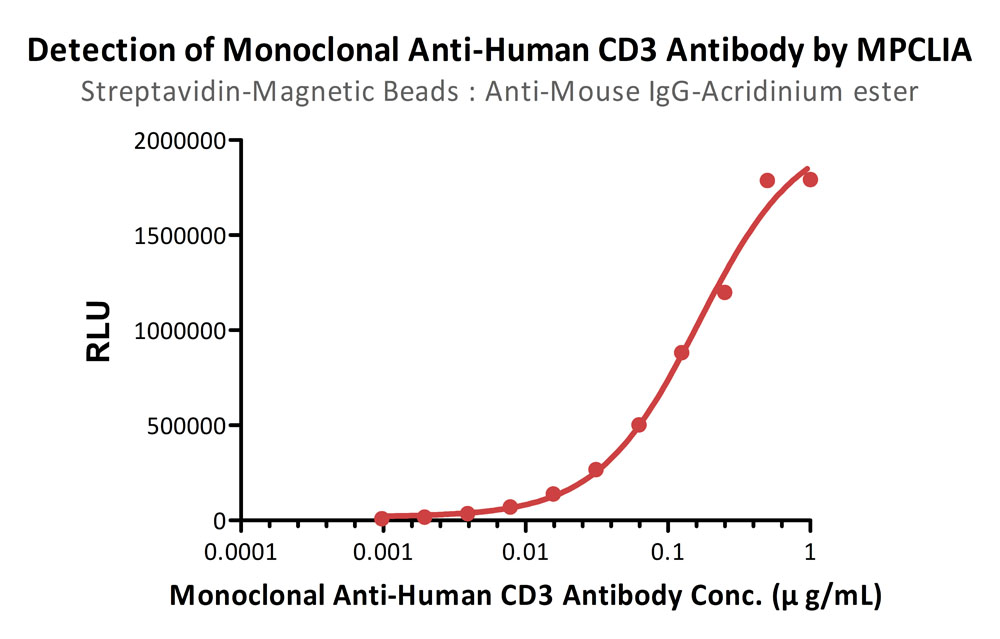
When used the Chemiluminescent Substrate Solution (AE Marker) (Cat. No. ABK-001) in a sandwich MPCLIA Assay for detection of Monoclonal Anti-Human CD3 Antibody, Mouse IgG2a (Clone: OKT3), premium grade. Immobilized 0.04 μg /Test of Biotinylated Human CD3E&CD3D Heterodimer Protein, His,Avitag&Tag Free (Cat. No. CDD-H82W6) to the Streptavidin-Magnetic Beads (recommended for MPCLIA) (Cat. No. MPC-A006, 20 μg beads/Test), incubated with 100 μL /Test of Monoclonal Anti-Human CD3 Antibody, Mouse IgG2a (Clone: OKT3), premium grade (Cat. No. CDE-M120a) at increasing concentration coupled to Anti-Mouse IgG-Acridinium ester(Cat. No. AMG-S163, 0.04 μg /Test). Detection was performed with sensitivity of 0.98 ng/mL in Magnetism particulate chemiluminescence immunoassay (MPCLIA) (KEYSMILE, SMART 6500S) (QC tested).
Protocol
Customer Reviews Writing Reviews

FAQ
- product
Can lyophilized proteins remain stable during room-temperature shipping or temporary room-temperature exposure?
In general, lyophilized proteins remain stable during room-temperature shipping or temporary exposure to room-temperature conditions.
Many ACROBiosystems recombinant proteins are supplied in lyophilized (freeze-dried) form. The lyophilization process effectively removes moisture from the product, helping reduce degradation-related reactions and improve protein stability during transportation and storage.
To evaluate the stability of lyophilized proteins under normal temperature conditions, ACROBiosystems conducted a stability study on 11 representative lyophilized protein products at 37°C. The study demonstrated that these proteins maintained good quality stability after storage at 37°C for approximately 20 days. Based on these validation results, temporary room-temperature exposure during shipping or handling is generally not expected to have a significant impact on product quality or downstream application performance.
To ensure optimal long-term stability, products should be stored according to the storage conditions specified in the product Certificate of Analysis (COA) upon receipt.
Supporting Document
Recent Advances
[North America]: +1 800-810-0816
[Switzerland]: +41 800 040 012
[Asia & Pacific]: +86 400-682-2521