







 COA
COA


- Product Details
- Performance Data
- Reviews & Citations
- Resources

1/4
Monoclonal Anti-Bevacizumab Antibody, Mouse IgG1 (AY10) (Cat. No. BEB-Y10) is a mouse monoclonal antibody produced from a hybridoma generated by fusion of SP2/0 myeloma cells with mouse B lymphocytes.
Hybridoma Monoclonal
AY10
Mouse IgG1, Kappa
Mouse
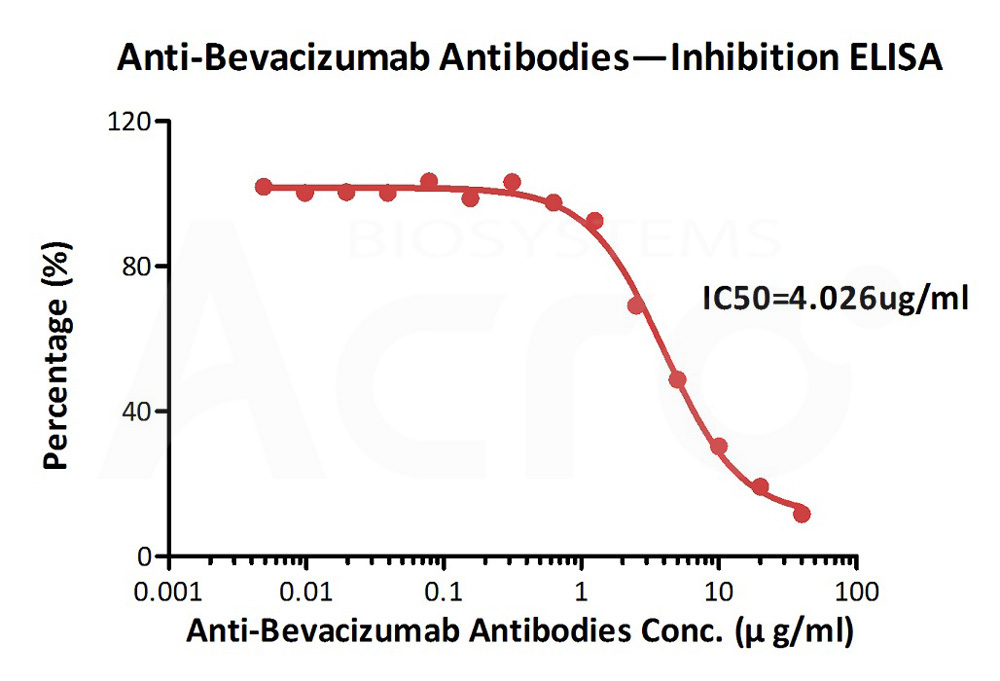
AY10 is an inhibitory anti-idiotype monoclonal antibody that specifically recognizes Bevacizumab. No detectable binding to the tested human IgG1 controls, VEGF165, Trastuzumab, or Adalimumab was observed under the tested conditions. AY10 inhibits the binding of Bevacizumab to VEGF165.
Application | Recommended Use |
ELISA | 6-60 ng/mL |
Blocking Elisa | 1.65-9.77 μg/mL |
PK Assay Development | Recommended for use as the capture antibody in a sandwich ELISA for Bevacizumab quantification during PK assay development, paired with biotinylated Anti-Bevacizumab Antibody (AY13) as the detection antibody. |
* Recommended dilutions are for reference only. Optimal working concentrations may vary depending on your consumables, reagents, and assay conditions. We recommend optimizing for your specific system. No warranty is made regarding performance at any specific dilution.
Protein A purified.
Less than 5%, as determined by SEC-MALS.
Please refer to the Certificate of Analysis (CoA).
Lyophilized
Lyophilized from a 0.22 μm-filtered solution in Tris (pH 7.5) containing 100 mM Glycine, 25 mM Arginine and 150 mM NaCl, with trehalose as protectant.
Please contact us for customized product forms or formulations.
Please refer to the Certificate of Analysis (CoA) for specific instructions.
Lyophilized product is shipped at ambient temperature.
For long term storage, the product should be stored in a lyophilized state at -20°C or lower.
Please avoid repeated freeze-thaw cycles.
Product Specific Notices: For research use only.