


 Sep 3, 2026
 Page Views:316


Fc Function in ADCs: When to Retain, Enhance, or Silence It
How FcγR interactions can preserve effector activity, enable payload delivery to myeloid cells, or affect the interpretation of preclinical results
OVERVIEW
Target, linker, and payload often dominate ADC design discussions, while Fc is treated as a fixed component of the antibody scaffold. Recent studies show why that assumption deserves closer examination. Depending on the molecule and intended mechanism, FcγR engagement may preserve antibody effector activity, provide a route for payload delivery to myeloid cells, or influence ADC exposure in a preclinical model. Conversely, an Fc-silenced ADC may retain measurable receptor binding without detectable downstream function. The relevant question is therefore not simply whether Fc activity should be retained or removed, but what Fc profile the intended mechanism requires—and what evidence is needed to demonstrate it.
Retaining or Enhancing Fc Function
Conjugation does not necessarily eliminate the Fc effector activity of the parent antibody. Tsao and colleagues compared trastuzumab with trastuzumab emtansine (T-DM1) and trastuzumab deruxtecan (T-DXd) in FcγR reporter and macrophage phagocytosis assays. Both ADCs activated human FcγRIIIa in the presence of HER2-positive tumor cells and mediated ADCP by human monocyte-derived macrophages at levels similar to trastuzumab under the conditions tested.
T-DXd treatment also increased extracellular ATP and HMGB1 release and surface calreticulin, which are associated with immunogenic cell death. When macrophages and antigen-specific CD8⁺ T cells were included, T-cell proliferation and activation markers increased. These findings show that payload-induced cell death and FcγR-mediated phagocytosis can occur in the same experimental system, but they do not establish how much Fc function contributes independently to clinical efficacy.
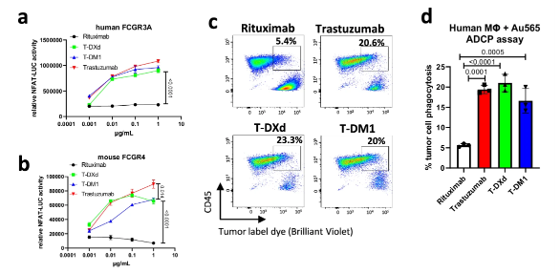
Figure 1. T-DM1 and T-DXd activated human FcγRIIIa reporter signaling and mediated macrophage ADCP in the tested HER2-positive systems. Adapted from Tsao L-C et al., Nature Communications (2025), Figure 5a–d.
Belantamab mafodotin (GSK2857916) uses an afucosylated anti-BCMA IgG1 to enhance Fc effector function and carries an MMAF payload. In BCMA-positive multiple myeloma cell lines and patient-derived bone marrow samples, Tai and colleagues observed BCMA-dependent internalization and payload-mediated killing together with enhanced NK-cell-mediated ADCC. The ADCC activity still required binding to BCMA-positive cells; the data do not support activity against BCMA-negative or antigen-loss cells.
FcγRI-Mediated Payload Delivery to Myeloid Cells
FcγR engagement can also affect payload delivery. Cetinbas and colleagues studied HER2- and NaPi2b-targeted ADCs carrying a STING agonist. In antigen-coated and tumor-cell/THP-1 co-culture systems, wild-type Fc ADCs activated STING-dependent reporter signaling, whereas Fc-mutant and non-binding controls produced minimal activity.
Flow cytometry separately showed internalization of the targeted wild-type Fc ADC by THP-1 cells in the presence of the corresponding antigen. FcγRI knockout substantially reduced reporter activity and almost completely inhibited ADC binding. Together with the Fc-mutant and antigen controls, these results support antigen-dependent, FcγRI-mediated delivery into myeloid cells.
This mechanism may be relevant for immune-stimulatory ADCs designed to act in tumor cells and myeloid cells. It should not be generalized to conventional cytotoxic ADCs without evidence from the specific molecule and model. Target biology, payload class, Fc structure, receptor expression, and cellular composition can all affect the contribution of myeloid-cell uptake.
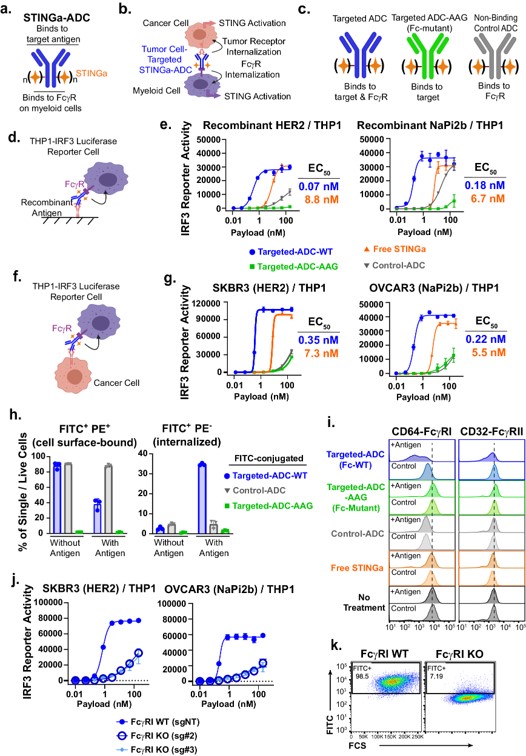
Figure 2. STING activation by HER2- or NaPi2b-targeted ADCs in the tested THP-1 systems required both the corresponding target antigen and FcγRI. Fc-mutant ADCs, non-binding controls, and FcγRI-knockout THP-1 cells helped define the mechanism. Adapted from Cetinbas NM et al., Nature Communications (2024), Figure 1e and 1g–k.
Fc Silencing and Residual FcγR Activity
Fc silencing is used when FcγR-mediated activity is not required for the intended mechanism. However, a silenced Fc does not always show complete loss of measurable FcγR binding.
FZ-AD005, a DLL3-targeted ADC, contains L234F/L235E/P331S substitutions to reduce Fc effector function. Guo and colleagues reported FcγR affinities of approximately 550 nmol/L for FcγRI, 13.29 μmol/L for FcγRIIa, and 6.1 μmol/L for FcγRIIIa. Despite this measurable residual binding, neither FZ-AD005 nor its unconjugated antibody elicited robust ADCC, ADCP, or complement-dependent cytotoxicity in the PBMC-based assays at concentrations up to 10 μg/mL. DLL3 binding, internalization, DXd release, and FcRn binding were retained.
For this construct, residual binding did not translate into robust effector activity under the conditions tested. Binding and cell-based assays therefore answer different questions: one characterizes the remaining FcγR interaction, while the other determines whether that interaction produces receptor signaling or effector-cell activity.
TUB-040 uses a different Fc-silencing approach. The NaPi2b-targeted ADC contains LALA substitutions, is conjugated to an exatecan payload using P5 technology, and has a drug-to-antibody ratio of 8. Vogl and colleagues reported highly reduced or absent interactions between the tested FcγRs and both the Fc-silenced antibody and TUB-040 compared with the wild-type Fc antibody in a competition binding assay. Separate experiments showed that the ADC retained binding to NaPi2b-positive cells, internalization, and target-dependent cytotoxicity.
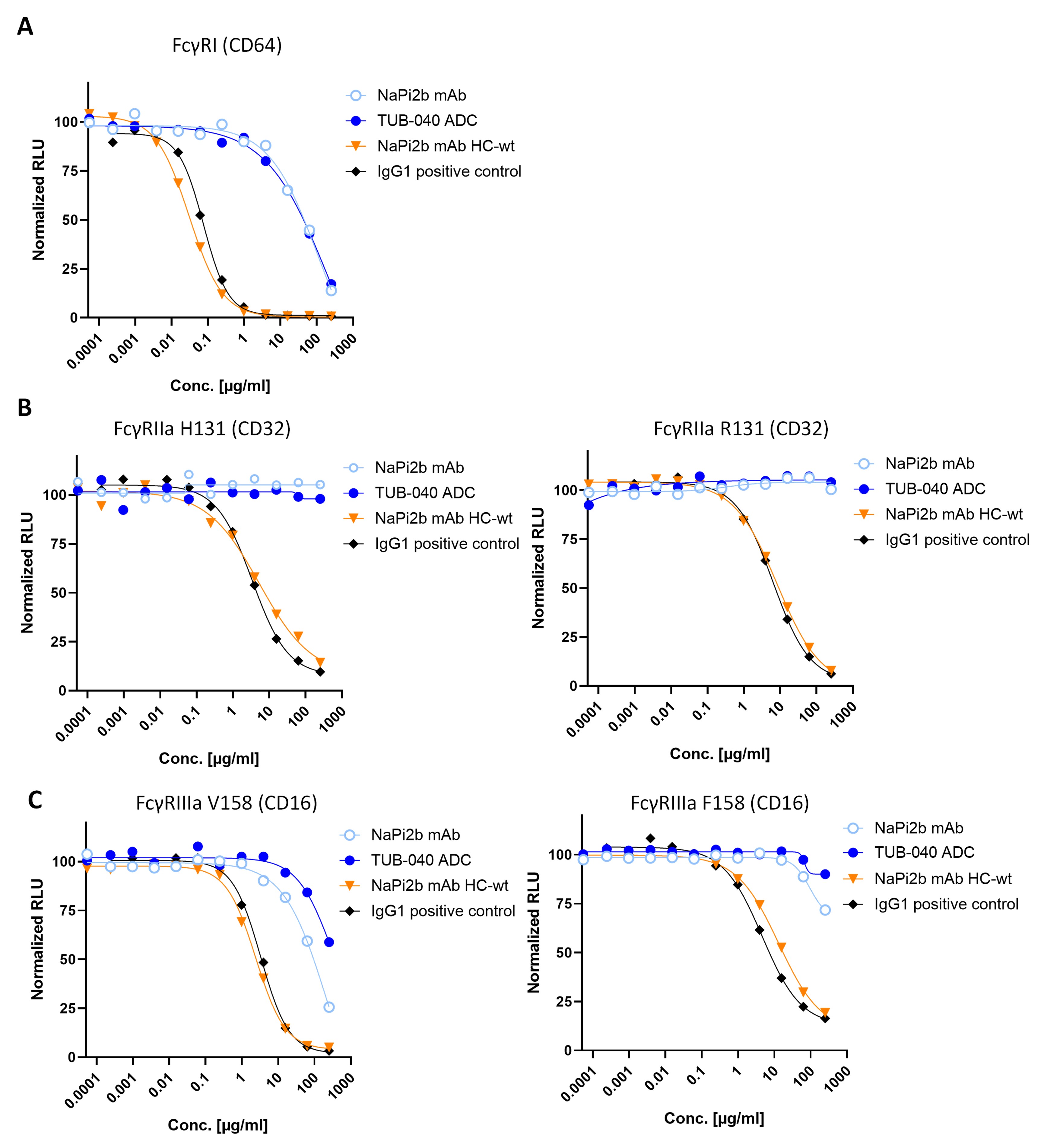
Figure 3. The Fc-silenced NaPi2b antibody and TUB-040 showed highly reduced or absent FcγR interactions relative to the wild-type Fc antibody in the competition binding assay. This result does not by itself establish an absence of cell-based effector activity. Adapted from Vogl AM et al., Molecular Cancer Therapeutics (2025), Supplementary Figure S9.
The FZ-AD005 and TUB-040 studies establish Fc-silenced phenotypes for these molecules, but they do not show that Fc silencing alone widens the therapeutic window. That conclusion would require controlled comparison with wild-type Fc constructs matched for the antibody, linker-payload, drug-to-antibody ratio, glycosylation, and aggregation profile. FZ-AD005 and rovalpituzumab tesirine, for example, differ in their antibody, linker, and payload as well as their Fc design, so differences in safety cannot be attributed to Fc design alone.
Mouse Models Can Affect Fc-Related PK and Efficacy
FcγR biology in an animal model can alter observed ADC clearance and efficacy. Li and colleagues reported abnormally rapid clearance of several human or chimeric antibodies and ADCs in NSG mice. Reducing FcγR binding restored exposure and antitumor activity in the models studied, indicating that mouse strain-specific FcγR expression and cross-species Fc interactions can affect preclinical pharmacokinetic and efficacy results.
When Fc variants produce unexpected differences in exposure or efficacy, the result may reflect the host model as well as the ADC. FcγR expression in the mouse strain, cross-species FcγR binding, and the distribution of FcγR-positive myeloid cells should therefore be considered before attributing the difference to Fc design.
Match the Assay Strategy to the Fc Design
The assay strategy should reflect the role expected of Fc in the ADC. For ADCs designed to retain or enhance effector activity, comparisons should include the parent antibody, the ADC, and relevant Fc variants across FcγR binding, receptor activation, and direct ADCC or ADCP assays. If FcγR-mediated delivery to myeloid cells is part of the proposed mechanism, FcγR-binding-deficient constructs, receptor-blocking or knockout controls, antigen controls, and relevant co-culture models can help determine whether receptor engagement contributes to productive uptake.
For Fc-silenced ADCs, testing should confirm that FcγR binding and downstream activity are reduced to the intended level while antigen binding, internalization, payload activity, and FcRn binding are retained. Molecular assays can cover FcγRI, FcγRIIa, FcγRIIb, and FcγRIIIa, including mechanism-relevant allotypes. Cell-based assays can then address receptor activation, NK-cell ADCC, macrophage ADCP, myeloid-cell internalization, or activity in co-culture models.
FcγR Binding and Functional Characterization Tools
ACROBiosystems provides recombinant FcγR proteins, TR-FRET binding kits for CD16a, CD32a, and CD64, FcγR-overexpressing cells, and FcγR reporter cell lines. These formats support different levels of Fc characterization when comparing antibodies, ADCs, and engineered Fc variants.
Research question | Assessment level | Relevant research tools or models |
|---|---|---|
What is the ADC’s FcγR binding profile? | Molecular binding | FcγR recombinant proteins (e.g., CD16a, CD32a, CD64); TR-FRET binding assay kits |
Does FcγR engagement trigger receptor signaling? | Receptor activation | FcγR reporter cell assays or other receptor activation models |
Does FcγR engagement result in measurable effector-cell activity? | Effector function | NK cell–mediated ADCC, macrophage-mediated ADCP, or other study-specific cellular models |
Conclusion
No single Fc strategy is appropriate for every ADC. Retaining or enhancing Fc activity may preserve antibody effector function or support FcγR-mediated payload delivery, while silencing may be more suitable when those interactions are outside the intended mechanism. The appropriate evaluation strategy should follow the same logic: define the intended role of Fc first, then connect molecular binding with receptor activation, direct cell-based function, and results from a relevant preclinical model.