



pHintra™ Antibody Labeling Kit — Covalent pH-Sensitive Labeling for Antibody Internalization Studies
pHintra™ Antibody Labeling Kit
Covalent pH-Sensitive Labeling for Antibody Internalization Studies
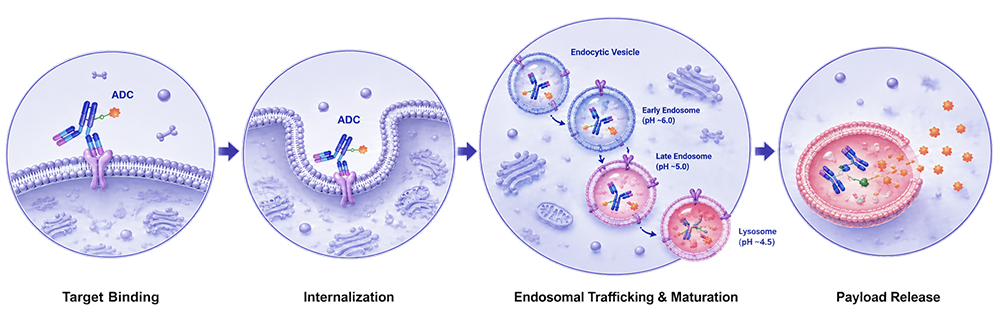
 Internalization efficiency is a critical readout of both drug delivery and mechanism of action for internalization-dependent ADCs.
Why Choose the pHintra™ Antibody Labeling Kit?

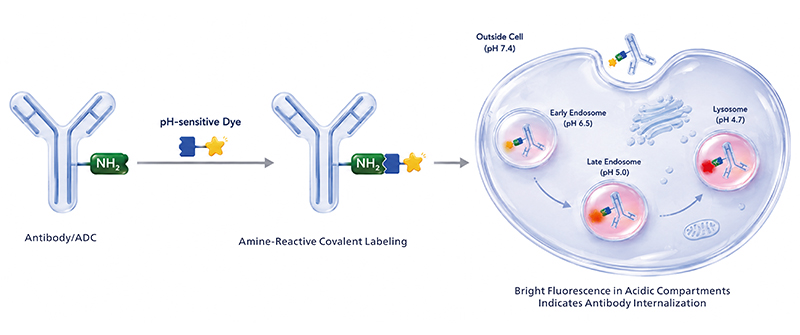
Amine-Reactive Covalent Labeling
Covalently labels primary amines on antibodies.
High Signal-to-Noise Ratio
Strong fluorescence with low background.

Acid-Responsive Em660 Signal
Fluorescence increases in acidic compartments.

30-Min Hands-on Time
Approximately 30 minutes of hands-on work with a total assay time of 2.5 hours.
Broad Antibody Compatibility
Supports antibodies from different species and subclasses, as well as ADCs.

Fully Pre-configured Kit
Includes all required reagents and a standardized protocol.
Product List
| Cat. No. | Molecule | Product Description | Order Now |
|---|---|---|---|
 Order Order |
How It Works
Emission: 660 nm
Kit Components
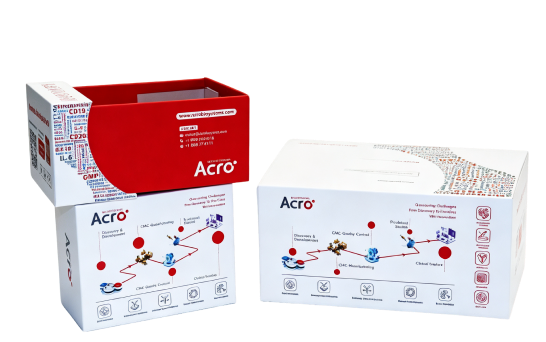
Box A — Storage -20℃
-
 pH-Sensitive Fluorescent Dye
-
Reaction Buffer
-
Quencher Reagent
Box B — Storage 2-8℃
-
Desalting Spin column
-
Purification & Storage Buffer
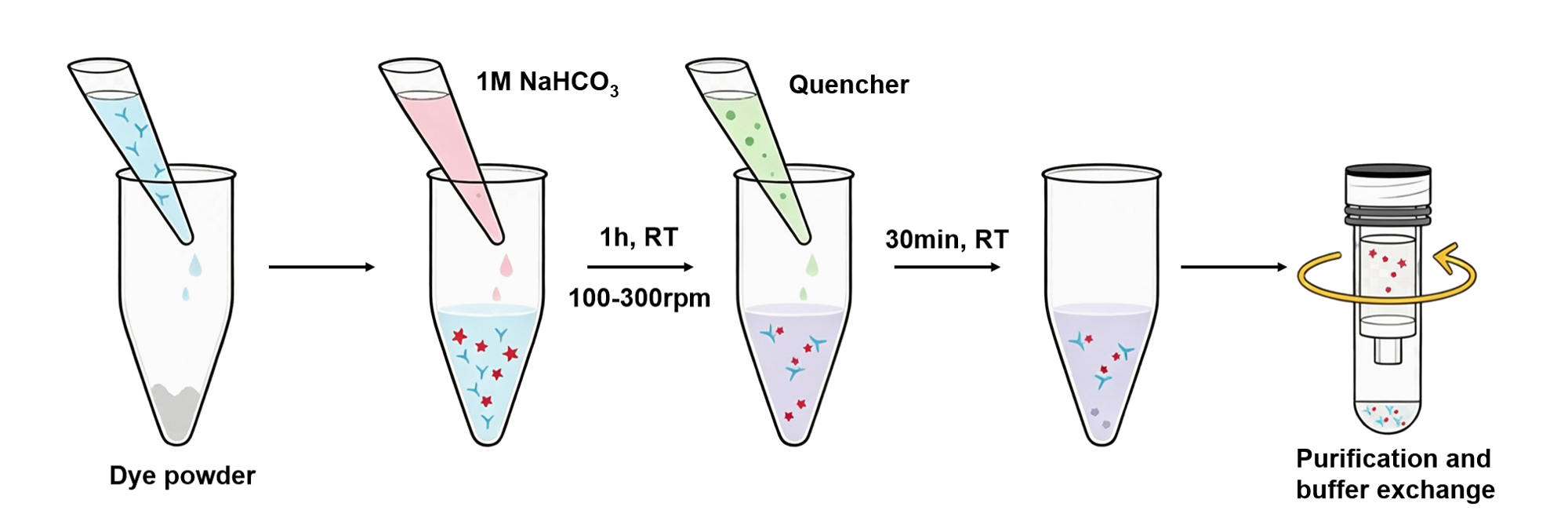
Quick Labeling Protocol
Validation Data
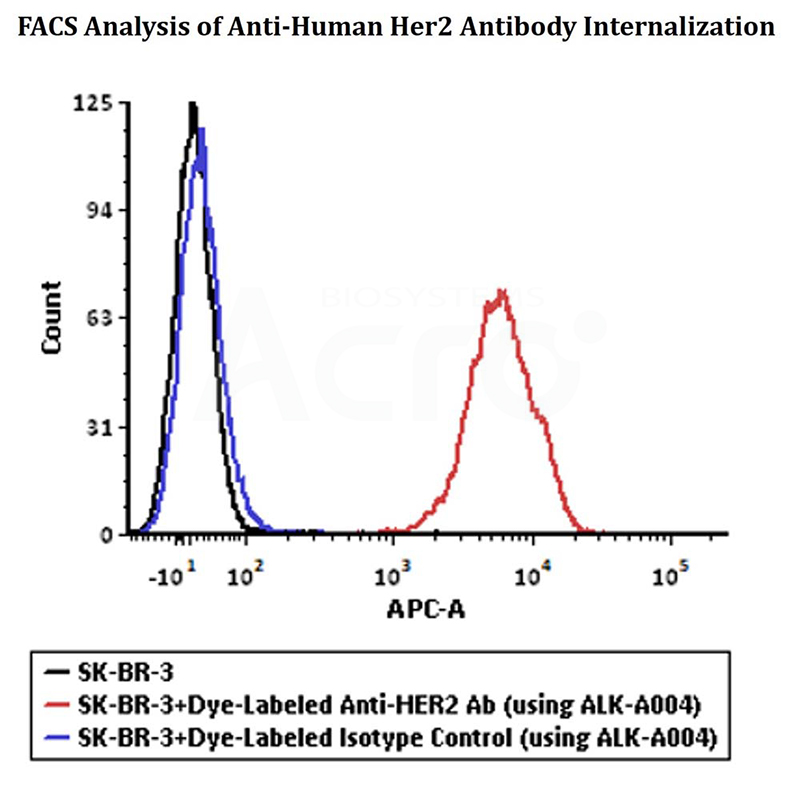
Anti-Her2 Ab and Human IgG1 isotype control were labeled using pH-Sensitive Fluorescent Dye Antibody Labeling Kit (Cat. No. ALK-A004). SK-BR-3 cells were treated with Dye Labeled Anti-Her2 Ab and Dye Labeled Isotype Control separately at 37℃ for 4 hours, then analysis by Flow cytometric. APC signal was used to evaluate the internalization signal.
Request Protocol
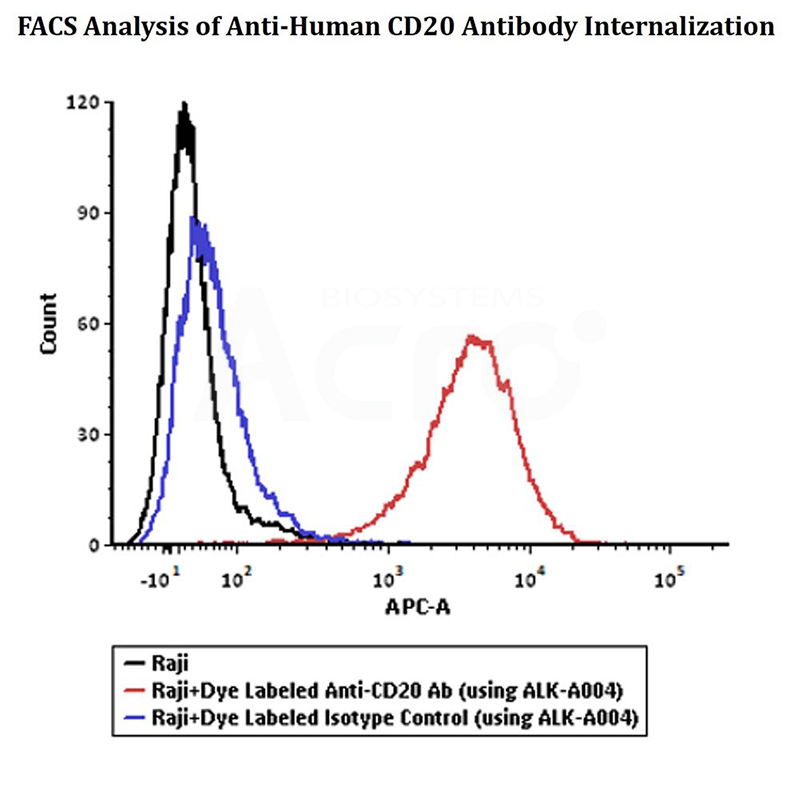
Anti-CD20 Ab and Human IgG1 isotype control were labeled using pH-Sensitive Fluorescent Dye Antibody Labeling Kit (Cat. No. ALK-A004). Raji cells were treated with Dye Labeled Anti-CD20 Ab and Dye Labeled Isotype Control separately at 37℃ for 4 hours, then analysis by Flow cytometric. APC signal was used to evaluate the internalization signal.
Request Protocol
ALK-A004 generates an APC signal that accurately reflects antibody internalization.
pHintra™ Internalization Detection Reagent
For human IgG antibodies and ADCs.
Need a Ready-to-Use Internalization Reagent?
Fc-Specific Binding | No Antibody Pre-Labeling or Purification
View Product DetailsCompare pHintra™ Internalization Detection Solutions
Ready-to-use Fc-binding Detection
-
Human IgG antibodies and human IgG-based ADCs
-
Approximately 10-minute reagent–antibody complex formation
-
No antibody pre-labeling or post-label purification

Rapid screening

Early-stage research

Target validation

Direct Covalent Labeling
-
Antibodies from different species and subclasses, as well as ADCs
-
Primary amine–reactive covalent labeling
-
Approximately 30 minutes of hands-on work with spin-column purification

ADC research

Mechanism research

Drug optimization
Choose the Right Internalization Detection Strategy

| Category |
Ready-to-Use Internalization Assay
|
Covalent Labeling Internalization Assay
|
|---|---|---|
 Labeling Method Labeling Method
|
Fc-specific non-covalent labeling | Primary amine-based covalent labeling |
 Antibody Compatibility Antibody Compatibility
|
Human IgG antibodies & ADCs | Antibodies/ADCs from different species and subclasses |
 Preparation Time Preparation Time
|
Approximately 10 min antibody labeling | 30 min hands-on work |
 Detection Method Detection Method
|
Flow cytometry / Cell imaging | Flow cytometry / Cell imaging |
 Best Suited For Best Suited For
|
|
|
 Core Advantage Core Advantage
|
No purification required, approximately 10 min labeling | Broad compatibility across antibody species and subclasses, as well as ADCs |
Resource Sharing
Webinar playback and appointment
‘ADC Potency Analysis and Quality Control Technology Breakthrough’ Webinar Series
ACROBiosystems proudly presents the flagship 'ADC Potency Analysisand Quality Control Technology Breakthrough' live webinar series. This series will systematicallydeconstruct critical aspects ofADC drug development through five coremodules-from potency analysis to quality control technologiesempowering breakthroughs in ADC therapeutics by overcoming keytechnical bottlenecks.

Addressing Challenges in Antibody-Drug Conjugate Development
Here is the brief recap of the webinar:ADCs have the potential to enable 'precision medicine' with a wide market reach.Challenges in ADCs include managing Target Affinity, enhancing payload conjugation, and assessing Payload Delivery in vivo Pharmacokinetics. We can provide high-quality solutions to address these challenges.

Building the Perfect Antibody-based Therapeutic from Selection to Engineering and Manufacturing
In this webinar, discover how advanced techniques such as Al-driven candidate selection optimization of antibody sequences, and precise conjugation methods come together to address some of the current challenges in antibody-based therapeutics.

Insight Article

Brochure Download



- Why Perform ADC Internalization Analysis?
- Why Choose the pHintra™ Antibody Labeling Kit?
- Product List
- How It Works
- Validation Data
- Compare pHintra™ Internalization Detection Solutions
- Choose the Right Internalization Detection Strategy
- Related Recommendations
- Resource Sharing