


 Nov 26, 2026
 Page Views:61


Five Primary Expression Platforms: Mechanisms & Trade-Offs
Each expression system operates within a distinct cellular physiology, chaperone machinery, and secretome dynamics.[1]
Table 1: Recombinant Expression Host Selection & Performance Comparison Matrix
Expression Host | Post-Translational Modification Profile | Folding & Disulfide Assembly Environment | Volumetric Yield & Kinetic Profile | Typical Target Applications |
|---|---|---|---|---|
Bacterial (E. coli) | Lacks eukaryotic ER/Golgi glycosylation; other modifications possible | Reducing cytoplasm; frequent inclusion bodies requiring refolding | High yield (grams/L); rapid 20-minute doubling time | Simple enzymes, scFv / VHH fragments, unglycosylated structural domains |
Yeast (Pichia / S. cerevisiae) | Core N/O-glycosylation with high-mannose chains | Secretory pathway with protein disulfide isomerase (PDI) assistance | High-density fermentation; scalable extracellular secretion | Industrial biocatalysts, secreted enzymes, simple growth factors |
Baculovirus-Insect (Sf9 / High Five) | Paucimannose N-glycans (Man3GlcNAc2); phosphorylation | Supports multi-subunit complex assembly and membrane targets | Moderate to high yield; transient lytic infection cycle | Intracellular kinase complexes, multi-subunit enzymes, structural targets |
Mammalian (HEK293 / CHO) | Can produce complex N/O-glycans and terminal sialylation | Native endoplasmic reticulum folding & chaperone networks | Moderate yield; scalable suspension batch / fed-batch | Complex cytokines, immune checkpoints, full-length receptors, therapeutic antibodies |
Cell-Free (CFPS) | Controllable via exogenous enzyme supplementation | Open reaction matrix; customizable redox and chaperone additions | Rapid synthesis in hours; limited batch reaction volumes | Highly toxic proteins, membrane channels, non-canonical amino acid incorporation |
Bacterial Expression Platforms (Escherichia coli)
Escherichia coli remains a widely used host due to its well-characterized genetics, rapid doubling time (as short as ~20 minutes under favorable conditions), and low-cost media formulations. Expression vectors using promoters such as bacteriophage T7 can support high-level protein production.[2]
However, the reducing environment of the bacterial cytoplasm can hinder disulfide bond formation and contribute to the misfolding of overexpressed, hydrophobic polypeptides into insoluble inclusion bodies.[2] While inclusion bodies can be recovered through chaotropic denaturation (using 6 M Guanidine-HCl or 8 M Urea) and subsequent dilution refolding, recovering native bioactivity requires extensive trial-and-error optimization.
Yeast Expression Systems (Pichia pastoris and Saccharomyces cerevisiae)
Yeast platforms combine the rapid growth kinetics of single-celled microorganisms with basic eukaryotic secretory machinery. Pichia pastoris utilizes the tightly regulated alcohol oxidase 1 (AOX1) promoter to drive high-density extracellular protein secretion upon methanol induction, simplifying cell-separation during downstream operations.[1]
Yeast systems execute core N- and O-linked glycosylation; however, they can produce high-mannose glycan structures that vary by species and strain.[1] These high-mannose glycans can alter clearance rates, induce immunogenicity in mammalian models, or cause steric hindrance near ligand-binding interfaces.
Baculovirus-Insect Cell Platforms (Sf9 and High Five)
Insect cell platforms infected with recombinant baculovirus (Autographa californica multiple nucleopolyhedrovirus) provide higher eukaryotic chaperone capacity, making them suitable for expressing multi-subunit complexes, large cytosolic enzymes, and kinase cascades. Insect cells perform post-translational phosphorylation and N-glycosylation.[1]
The resulting N-glycans are typically trimmed into simple paucimannose structures (Man3GlcNAc2 with core alpha-1,6 or alpha-1,3 fucose) rather than complex human-like multi-antennary chains. This structural difference can make insect-derived proteins useful in structural biology (crystallography and Cryo-EM), where uniform, trimmed glycan trees facilitate lattice formation.
Mammalian Expression Platforms (Human HEK293 and CHO)
Mammalian suspension systems represent the benchmark for producing complex human therapeutic targets, cytokines, and cell-surface receptors. Within the endoplasmic reticulum and Golgi apparatus, mammalian cells perform a range of post-translational modifications, including:
• Complex Multi-Antennary N-Glycosylation: Formation of branched glycan structures, with fucosylation and galactosylation depending on the host and construct.
• Terminal Sialylation: Sialic acid capping (Neu5Ac) that can affect charge and pharmacokinetics.
• Chaperone-Assisted Isomerization: Endoplasmic reticulum networks (BiP, calnexin, and PDI) coordinate complex disulfide bond bridging and multi-subunit quaternary assembly.
Human HEK293 cells provide human-specific glycan branching with glycan profiles that may differ from CHO-derived proteins; the relevant glycosylation pattern should be verified for each product.[1]
Cell-Free Protein Synthesis (CFPS)
Cell-Free Protein Synthesis bypasses the constraints of living host cells by utilizing cell lysates (derived from E. coli, wheat germ, or mammalian extracts) supplemented with exogenous amino acids, energy regeneration systems, and linear or plasmid DNA templates. Because CFPS operates as an open in vitro biochemical system, researchers can directly add synthetic detergents, synthetic liposomes, or redox-shuffling reagents during synthesis.[1,3] This open configuration enables the rapid synthesis of cytotoxic proteins, membrane channels, and proteins containing non-canonical amino acids within hours.
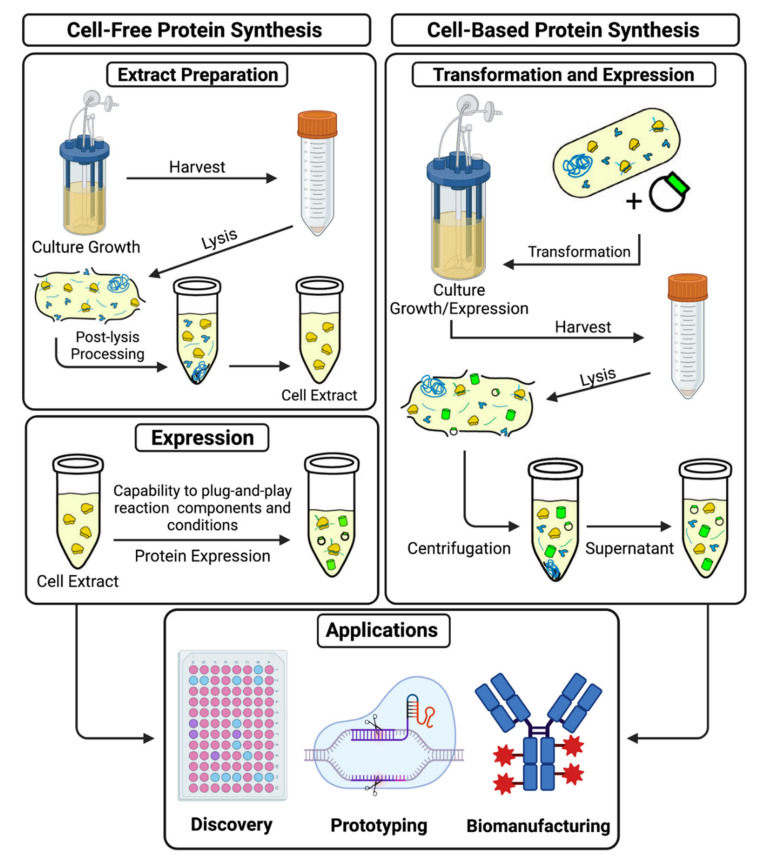
Figure 1. Comparison of cell-free and cell-based protein synthesis workflows, including extract preparation, protein expression, and representative applications.
Source: https://doi.org/10.3390/life11121367
Maximizing the yield of biologically active recombinant proteins requires balancing the rate of transcription and translation against the host cell’s folding capacity.
Inducer Titration and Transcriptional Regulation
In chemically inducible expression systems, the concentration of the inducing agent can influence transcriptional output:
• Bacterial Systems: Titrating Isopropyl beta-D-1-thiogalactopyranoside (IPTG) over a 0.1–1.0 mM range can modulate T7 promoter transcription. Reducing IPTG concentrations lowers mRNA synthesis rates, preventing newly translated polypeptides from overwhelming host DnaK/GroEL chaperone networks.
• Yeast Systems: Controlled, continuous methanol feeding in Pichia pastoris prevents cellular starvation while sustaining high AOX1 promoter activation.
• Mammalian Systems: Supplementing chemical enhancers (such as sodium butyrate or valproic acid) enhances histone acetylation, increasing transcriptional accessibility and protein volumetric titers in transient transfection protocols.
Temperature Tuning and Biphasic Cultivation
Temperature strongly influences translation velocity, hydrophobic interaction thermodynamics, and molecular chaperone activity. Bioprocess engineers implement biphasic thermal strategies to decouple cellular growth from recombinant protein synthesis:
• Phase 1: Biomass Expansion (37°C): Bacterial and mammalian cultures may be maintained near 37°C during growth to maximize specific growth rates and rapidly accumulate dense host cell biomass without imposing metabolic stress.
• Phase 2: Soluble Induction (16°C–25°C in Bacteria; 31°C–33°C in Mammalian Cells): Upon inducer addition, the cultivation temperature is shifted down. Depending on the host and target, this thermal downshift can reduce expression rate and aggregation and improve the recovery of soluble, active protein.[2,4]
Predictive In Silico Optimization
Modern expression workflows increasingly deploy machine learning models during the sequence design phase to forecast production outcomes. Predictive algorithms can use sequence and structural features to estimate secretion efficiency or solubility. These in silico predictions may help researchers adjust construct boundaries, select optimal signal peptides, and eliminate expression bottlenecks before initiating wet-lab fermentation.
Key Challenges in Recombinant Protein Expression
High total expression can still yield little soluble, active protein. In E. coli, a target may accumulate in inclusion bodies, and its activity must be checked if refolding is required. For secreted proteins, the relevant yield is the amount of intact target recovered from the culture medium. For glycosylated or multi-subunit proteins, the host must also support the modifications and assembly needed for the intended function. These differences guide the choice between adjusting induction or temperature and reconsidering the expression platform.
Protein Misfolding and Inclusion Body Formation
High expression rates can exceed the host’s capacity to fold newly synthesized proteins. Incompletely folded chains may expose hydrophobic regions that interact with neighboring molecules, promoting aggregation. In E. coli, these aggregates can accumulate as inclusion bodies, increasing total target protein while limiting soluble recovery. Reducing induction strength or production temperature may improve the balance between synthesis and folding, although the outcome depends on the target.[2]
Recovering protein from inclusion bodies introduces an additional challenge. Solubilization and subsequent refolding require conditions that support the functional conformation while limiting reaggregation. Recovery in soluble form does not establish that the correct fold or activity has been restored. Refolded material therefore requires an assay relevant to its intended function.[2]
Post-Translational Modifications and Protein Processing
Post-translational modifications can influence protein folding, stability, and molecular recognition. Standard E. coli systems generally lack eukaryotic N-linked and O-linked glycosylation, while yeast, insect, and mammalian cells produce different glycan profiles. The required glycosylation pattern should therefore guide host selection. Disulfide bond formation also depends on the expression compartment. The reducing bacterial cytoplasm can hinder this process, whereas the bacterial periplasm and eukaryotic secretory pathway provide environments that support disulfide formation.[1,2]
Proteolytic processing can determine whether the expressed product has the intended mature sequence. Signal peptide removal and, where required, precursor cleavage must be compatible with the selected host. Incomplete or unintended cleavage can generate heterogeneous products. These processing requirements deserve particular attention when the protein’s activity depends on a specific mature terminus.[1]
Secretion Efficiency and Complex Protein Expression
For proteins secreted through the eukaryotic secretory pathway, the signal peptide influences entry into the endoplasmic reticulum (ER). Its performance depends on both the target and the host, so a signal that works well for one protein may perform poorly for another. Secretion also depends on ER folding and quality-control capacity. Increasing synthesis can place additional demands on this machinery without producing a corresponding increase in extracellular protein.[4]
After secretion, extracellular proteases may reduce intact protein recovery. Complex targets introduce further constraints. Multi-subunit proteins require coordinated expression and correct assembly, while membrane proteins require suitable membrane insertion and an environment that stabilizes their hydrophobic regions. Detecting the expressed chains alone is therefore insufficient to establish successful production of the functional target.[1]
or multi-subunit proteins, the host must also support the modifications and assembly needed for the intended function. These differences guide the choice between adjusting induction or temperature and reconsidering the expression platform.
Conclusion: Aligning Host Platforms with Translational Needs
Recombinant protein expression requires matching the target’s folding, post-translational modification, and assembly requirements to the capabilities of the expression platform.[1] Optimizing induction and culture temperature can improve soluble, active protein recovery, while persistent challenges—including misfolding, inclusion bodies, inefficient secretion, and incomplete complex assembly—require target-specific evaluation. Together, host selection, process optimization, and troubleshooting guide the production of functional proteins for the intended application.
ACROBiosystems supports recombinant protein research through its expression platforms and custom expression and scale-up services. HEK293-based production provides mammalian folding and glycosylation machinery that can benefit complex human targets. Product-specific evaluation of folding, glycosylation, and biological activity remains essential to determine whether the resulting protein meets the requirements of downstream research.