


Product Details
Source
Monoclonal Anti-Bevacizumab Antibody, Mouse IgG1 (AY12) (Cat. No. BEB-Y12) is a mouse monoclonal antibody produced from a hybridoma generated by fusion of SP2/0 myeloma cells with mouse B lymphocytes.
Antibody Type
Hybridoma Monoclonal
Clone
AY12
Isotype
Mouse IgG1, Kappa
Host Species
Mouse
Immunogen
Bevacizumab
Specificity
AY12 is an inhibitory anti-idiotype monoclonal antibody that specifically recognizes Bevacizumab. No detectable binding to the tested human IgG1 controls, VEGF165, Trastuzumab, or Adalimumab was observed under the tested conditions. AY12 inhibits the binding of Bevacizumab to VEGF165.
Application
ApplicationRecommended Use / PerformanceELISA11-61 ng/mLPurification
Protein A purified.
Aggregation
Less than 5%, as determined by SEC-MALS.
Concentration
Please refer to the Certificate of Analysis (CoA).
Form
Lyophilized
Formulation
Lyophilized from a 0.22 μm-filtered solution in Tris (pH 7.5) containing 100 mM Glycine, 25 mM Arginine, 150 mM NaCl and 0.01% Tween80, with trehalose as protectant.
Please contact us for customized product forms or formulations.
Reconstitution
Please refer to the Certificate of Analysis (CoA) for specific instructions.
Shipping
Lyophilized product is shipped at ambient temperature.
Storage
For long term storage, the product should be stored in a lyophilized state at -20°C or lower.
Please avoid repeated freeze-thaw cycles.
This product is stable after storage at:
- -20°C to -70°C for 12 months in lyophilized state;
- -70°C for 3 months under sterile conditions after reconstitution.
Notices
Product Specific Notices: For research use only.
ACRO Quality Management System
Customers Also Viewed
Performance Data
Bioactivity-ELISA

Monoclonal Anti-Bevacizumab Antibody, Mouse IgG1 (AY12) (Cat. No. BEB-Y12) was evaluated as a surrogate positive control in a bridging ELISA for anti-Bevacizumab ADA detection. Bevacizumab was immobilized at 5 μg/mL. Increasing concentrations of AY12 prepared in 10% human serum were added, followed by biotinylated Bevacizumab at 5 μg/mL. Detection was performed using HRP-conjugated streptavidin (QC tested).
Protocol
The specificity of Monoclonal Anti-Bevacizumab Antibody, Mouse IgG1 (AY12) (Cat. No. BEB-Y12) was evaluated by ELISA. Bevacizumab was immobilized at 1 μg/mL (100 μL/well). AY12 specifically recognized Bevacizumab, with no detectable binding to the tested human IgG1 controls, VEGF165, trastuzumab, or adalimumab under the tested conditions (Routinely tested).
Protocol
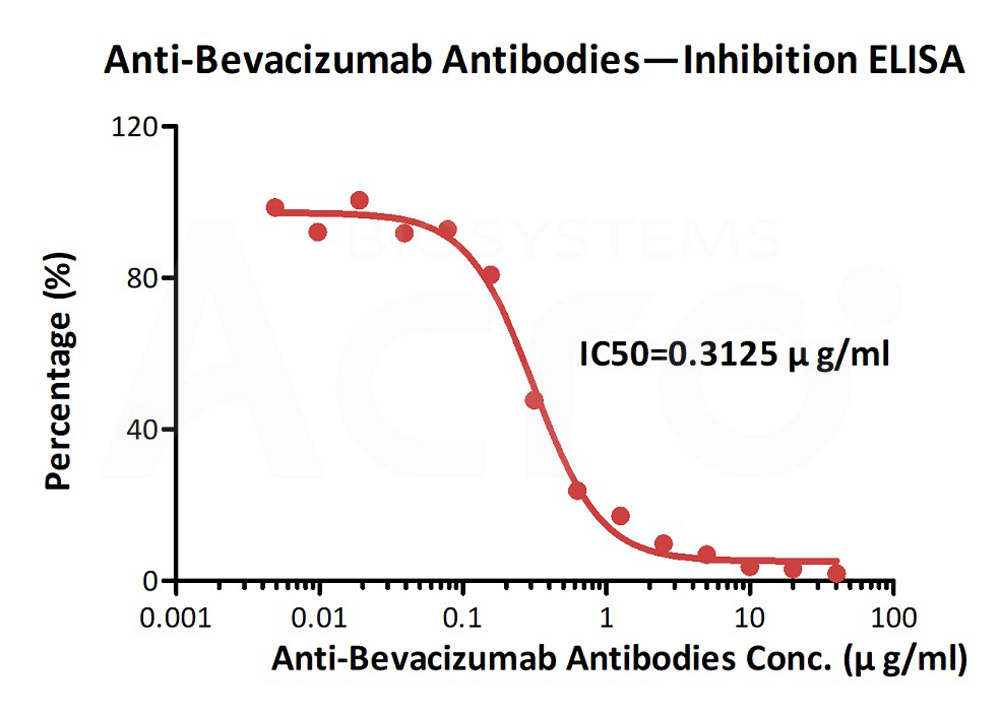
The ability of Monoclonal Anti-Bevacizumab Antibody, Mouse IgG1 (AY12) (Cat. No. BEB-Y12) to block Bevacizumab to VEGF165 was evaluated by ELISA. Bevacizumab was immobilized at 2 μg/mL (100 μL/well). Increasing concentrations of AY12 were tested for their ability to inhibit the biotinylated human VEGF165 to Bevacizumab. AY12 inhibited Bevacizumab binding to VEGF165 in a dose-dependent manner, with an IC₅₀ of approximately 0.30 μg/mL under the tested conditions (Routinely tested).
Protocol
Bioactivity-SPR

The binding affinity of Monoclonal Anti-Bevacizumab Antibody, Mouse IgG1 (AY12) (Cat. No. BEB-Y12) to Bevacizumab was determined by surface plasmon resonance (SPR). AY12 was captured on an anti-mouse IgG-coupled CM5 sensor chip, and Bevacizumab was injected as the analyte at serial concentrations (0.195-25 nM). The apparent equilibrium dissociation constant (KD) was determined to be 8.28E-11 M (82.8 pM).
Protocol
Customer Reviews Writing Reviews

FAQ
- product
Can lyophilized proteins remain stable during room-temperature shipping or temporary room-temperature exposure?
In general, lyophilized proteins remain stable during room-temperature shipping or temporary exposure to room-temperature conditions.
Many ACROBiosystems recombinant proteins are supplied in lyophilized (freeze-dried) form. The lyophilization process effectively removes moisture from the product, helping reduce degradation-related reactions and improve protein stability during transportation and storage.
To evaluate the stability of lyophilized proteins under normal temperature conditions, ACROBiosystems conducted a stability study on 11 representative lyophilized protein products at 37°C. The study demonstrated that these proteins maintained good quality stability after storage at 37°C for approximately 20 days. Based on these validation results, temporary room-temperature exposure during shipping or handling is generally not expected to have a significant impact on product quality or downstream application performance.
To ensure optimal long-term stability, products should be stored according to the storage conditions specified in the product Certificate of Analysis (COA) upon receipt.
Supporting Document
Background
Recent Advances
[North America]: +1 800-810-0816
[Switzerland]: +41 800 040 012
[Asia & Pacific]: +86 400-682-2521


