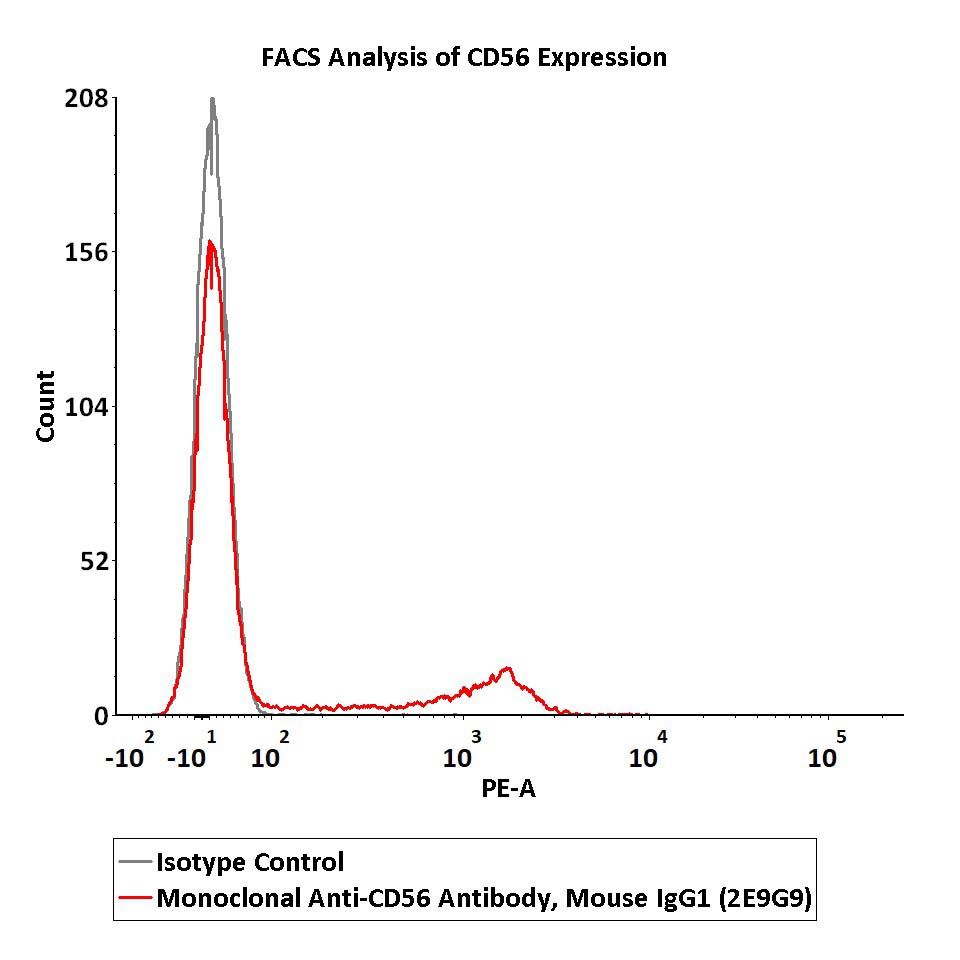


Monoclonal Anti-CD56 Antibody, Mouse IgG1 (2E9G9)

Cat. No. / Size
Price
Availability
Qty
CD6-MY2317G0-25ug
$55.00
CD6-MY2317G0-200ug
$320.00
CD6-MY2317G0
Sub-Total :
$ 0
Customize Product Request Quote
Contact Us
Contact Us
Sub-Total:
$ 0
  • Product Details
  • Performance Data
  • Reviews & Citations
  • Important Statement
  • Resources
Source

Monoclonal Anti-CD56 Antibody, Mouse IgG1 (2E9G9) is recombinantly expressed from human 293 cells (HEK293), which provides higher batch consistency and long term security of supply.

Antibody Type

Recombinant Monoclonal

Clone

2E9G9

Isotype

Mouse IgG1, Kappa

Host Species

Mouse

Reactivity

Human

Immunogen

Recombinant Human CD56 Protein is expressed from human 293T cells

Specificity

Specifically recognizes Human CD56 Protein.

Application

Flow Cytometry (Evaluation of the expression of CD56 on Human cells).

Form

Lyophilized

Formulation

Lyophilized from a 0.22 μm-filtered solution in PBS (pH 7.4) containing 0.03% PF68, with trehalose as protectant.

Please contact us for customized product forms or formulations.

Reconstitution

Please refer to the Certificate of Analysis (CoA) for specific instructions.

Shipping

Lyophilized product is shipped at ambient temperature.

Storage

For long term storage, the product should be stored at lyophilized state at -20°C or lower.

Please avoid repeated freeze-thaw cycles.

This product is stable after storage at:
  • -20°C to -70°C for 12 months in lyophilized state;
  • -70°C for 3 months under sterile conditions after reconstitution.
Notices

Product Specific Notices: For research use only.

Background

CD56 is a single transmembrane glycoprotein also known as NCAM (neural cell adhesion molecule), Leu-19, or NKH1. It is a member of the Ig superfamily. The 140 kD isoform is expressed on NK and NKT cells. CD56 is also expressed in the brain (cerebellum and cortex) and at neuromuscular junctions. Certain large granular lymphocyte (LGL) leukemias, small-cell lung carcinomas, neuronal derived tumors, myelomas, and myeloid leukemias also express CD56. CD56 plays a role in homophilic and heterophilic adhesion via binding to itself or heparan sulfate.