







 COA



- Product Details
- Performance Data
- Reviews & Citations
- Resources
1/3

ASGP-R 1, ASGPR 1, C-type lectin domain family 4 member H1, Hepatic lectin H1, HL-1
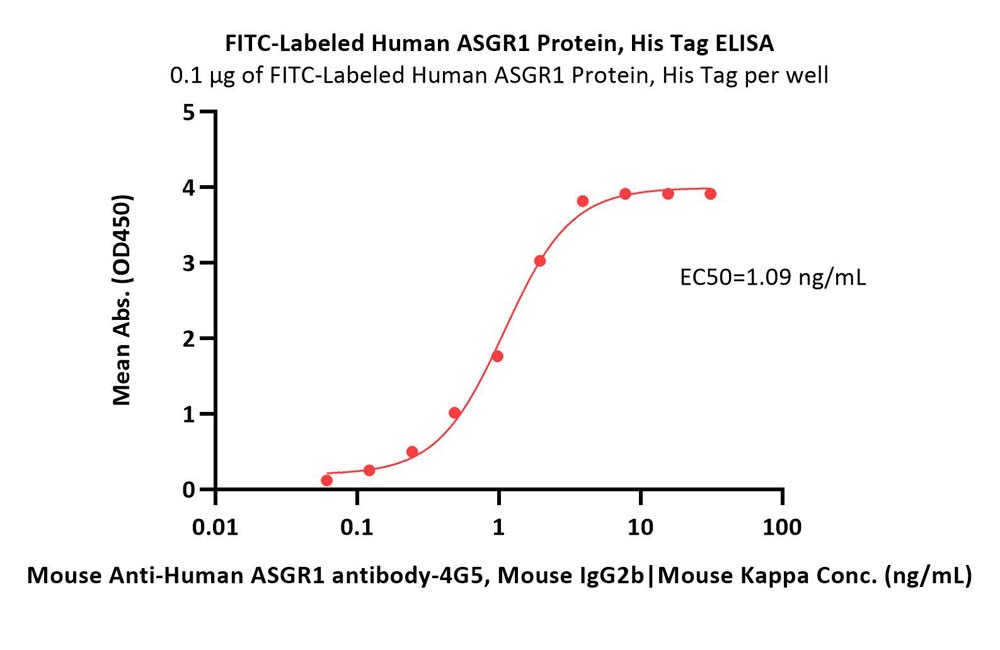
FITC-Labeled Human ASGR1 Protein, His Tag (AS1-HF243) is expressed from human 293 cells (HEK293). It contains AA Gln 62 - Leu 291 (Accession # P07306-1).
Predicted N-terminus: His
This protein carries a polyhistidine tag at the N-terminus.
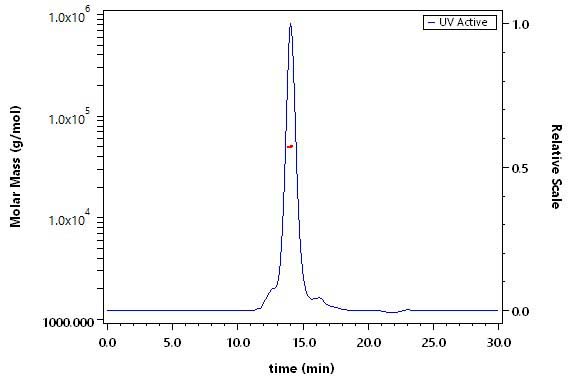
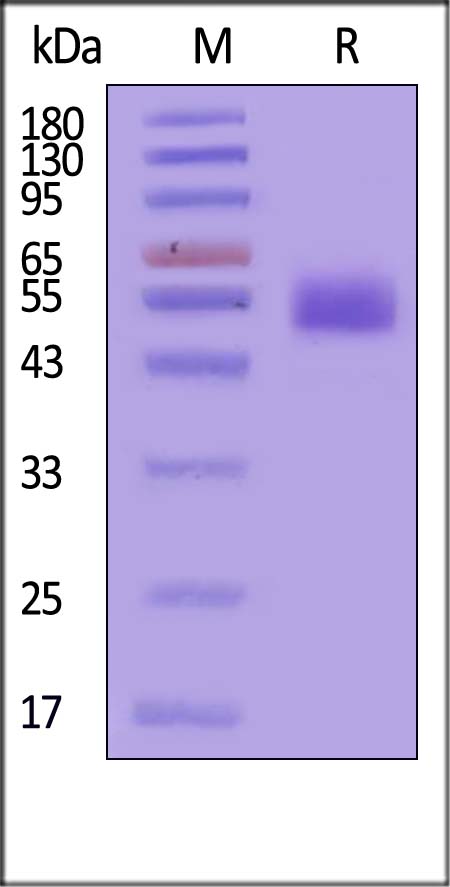
The protein has a calculated MW of 42.7 kDa. The protein migrates as 48-58 kDa when calibrated against Star Ribbon Pre-stained Protein Marker under reducing (R) condition (SDS-PAGE) due to glycosylation.
FITC
Excitation source: 488 nm spectral line, argon-ion laser
Excitation Wavelength: 488 nm
Emission Wavelength: 535 nm
The primary amines in the side chains of lysine residues and the N-terminus of the protein are conjugated with FITC using standard chemical labeling method. The residual FITC is removed by molecular sieve treatment during purification process.
>85% as determined by SDS-PAGE.
Lyophilized from 0.22 μm filtered solution in PBS, pH7.4 with trehalose as protectant.
Contact us for customized product form or formulation.
Please see Certificate of Analysis for specific instructions.
For best performance, we strongly recommend you to follow the reconstitution protocol provided in the CoA.
This product is shipped at ambient temperature.
For long term storage, the product should be stored at lyophilized state at -20°C or lower.
Please protect from light and avoid repeated freeze-thaw cycles.