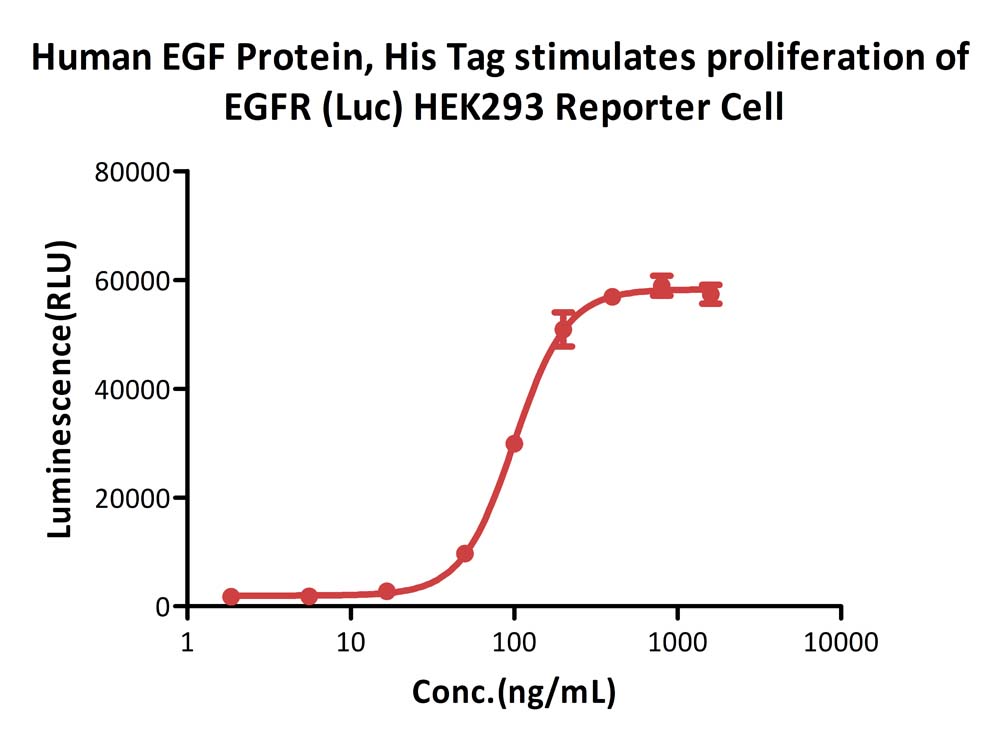

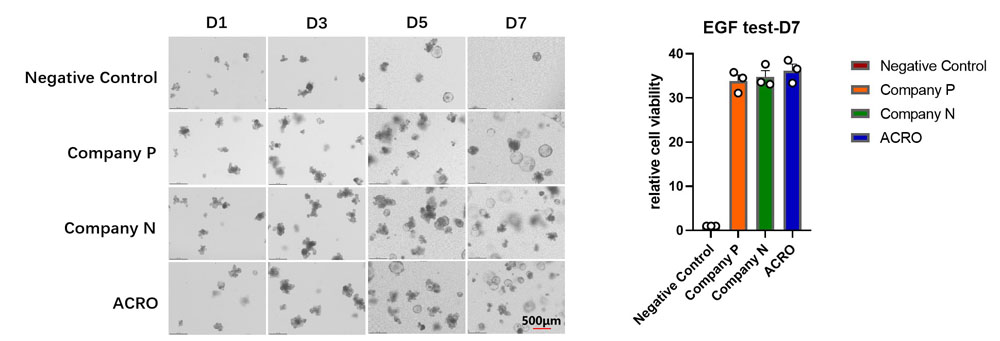
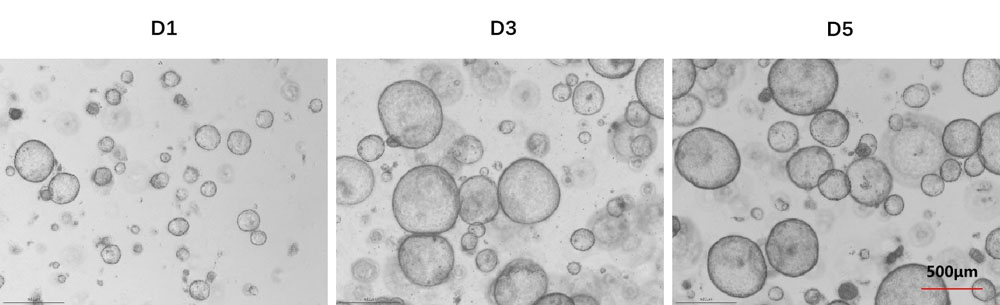

Human EGF Protein, His Tag

1/6
+3 View all
Cat. No. / Size
Price
Availability
Qty
EGF-H52H3-100ug
$70.00
In Stock - Delivery in 1-2 business days
EGF-H52H3-1mg (250ug X 4)
$180.00
In Stock - Delivery in 1-2 business days
EGF-H52H3
Sub-Total :
$ 0
0
Add to Cart
Customize Product Request Quote
Contact Us
Contact Us
Sub-Total:
$ 0
0
Add to Cart
  • Product Details
  • Performance Data
  • Reviews & Citations
  • Important Statement
  • Resources
Synonyms

EGF, URG, HOMG4

Source

Human EGF Protein, His Tag (EGF-H52H3) is expressed from human 293 cells (HEK293). It contains AA Asn 971 - Arg 1023 (Accession # P01133-1).

Molecular Characterization

This protein carries a polyhistidine tag at the N-terminus.

The protein has a calculated MW of 8.3 kDa. The protein migrates as 10-11 kDa when calibrated against Star Ribbon Pre-stained Protein Marker under reducing (R) condition (SDS-PAGE) due to glycosylation.

Endotoxin

Less than 0.1 EU per μg by the LAL method / rFC method.

Sterility

Negative

Mycoplasma

Negative

Purity

>95% as determined by SDS-PAGE.

Formulation

Lyophilized from 0.22 μm filtered solution in PBS, pH7.4 with trehalose as protectant.

Contact us for customized product form or formulation.

Reconstitution

Please see Certificate of Analysis for specific instructions.

For best performance, we strongly recommend you to follow the reconstitution protocol provided in the CoA.

Shipping and Storage

This product is shipped at ambient temperature.

For long term storage, the product should be stored at lyophilized state at -20°C or lower.

Please avoid repeated freeze-thaw cycles.
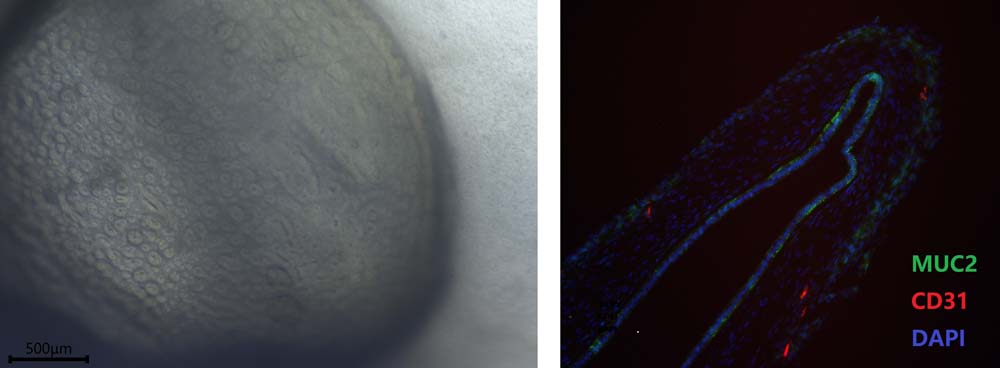
This product is stable after storage at:
  • -20°C to -70°C for 12 months in lyophilized state;
  • -70°C for 3 months under sterile conditions after reconstitution.

Background

Human epidermal growth factor (EGF) is also known as HOMG4 and URG,and is a growth factor that plays an important role in the regulation of cell growth, proliferation, and differentiation by binding to its receptor EGFR. Epidermal growth factor can be found in human platelets, macrophages, urine, saliva, milk, and plasma. EGF is the founding member of the EGF-family of proteins. Members of this protein family have highly similar structural and functional characteristics. All family members contain one or more repeats of the conserved amino acid sequence. The biological effects of salivary EGF include healing of oral and gastroesophageal ulcers, inhibition of gastric acid secretion, stimulation of D synthesis as well as mucosal protection from intraluminal injurious factors such as gastric acid, bile acids, pepsin, and trypsin and to physical, chemical and bacterial agents. Because of the increased risk of cancer by EGF, inhibiting it decreases cancer risk.