

Human IL-13 R alpha 1 & IL-13 Protein, Tag Free&His Tag (MALS verified)

Cat. No. / Size
Price
Availability
Qty
IL3-H52W3-50ug
$460.00
In Stock - Delivery in 1-2 business days
IL3-H52W3-500ug
$2,615.00
In Stock - Delivery in 2 weeks
IL3-H52W3
Sub-Total :
$ 0
Customize Product Request Quote
Contact Us
Contact Us
Sub-Total:
$ 0
  • Product Details
  • Performance Data
  • Reviews & Citations
  • Important Statement
  • Resources
Synonyms

IL-13 R alpha 1 & IL-13, IL13RA1 & IL13

Source

Human IL-13 R alpha 1 & IL-13 Protein, Tag Free&His Tag (IL3-H52W3) is expressed from human 293 cells (HEK293). It contains AA Gly 22 - Thr 343 (IL13RA1) & Gly 35 - Asn 146 (IL13) (Accession # P78552-1 (IL13RA1) & P35225 (IL13)).

Predicted N-terminus: Gly 22 (IL13RA1) & Gly 35 (IL13)

Molecular Characterization

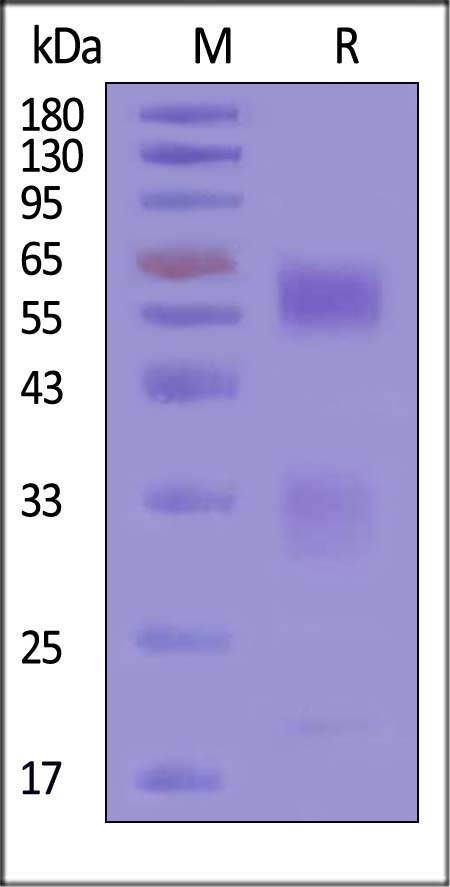
The protein has a calculated MW of 42.2 kDa (IL13RA1) & 19.0 kDa (IL13). The protein migrates as 29-39 kDa when calibrated against Star Ribbon Pre-stained Protein Marker under reducing (R) condition (SDS-PAGE).

The protein is designed as a heterodimer.

Endotoxin

Less than 1.0 EU per μg by the LAL method / rFC method.

Purity

>90% as determined by SDS-PAGE.

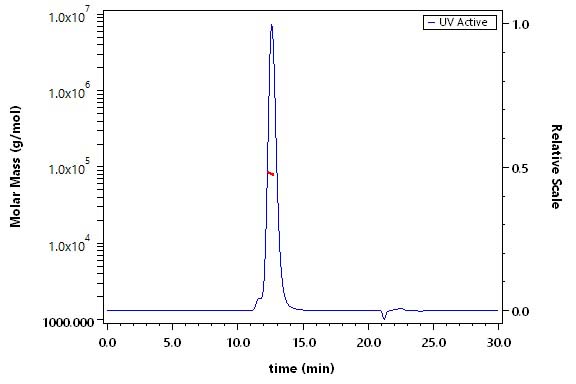
>90% as determined by SEC-MALS.

Formulation

Lyophilized from 0.22 μm filtered solution in PBS, pH7.4 with trehalose as protectant.

Contact us for customized product form or formulation.

Reconstitution

Please see Certificate of Analysis for specific instructions.

For best performance, we strongly recommend you to follow the reconstitution protocol provided in the CoA.

Shipping and Storage

This product is shipped at ambient temperature.

For long term storage, the product should be stored at lyophilized state at -20°C or lower.

Please avoid repeated freeze-thaw cycles.

This product is stable after storage at:
  • -20°C to -70°C for 12 months in lyophilized state;
  • -70°C for 3 months under sterile conditions after reconstitution.

Background

Interleukin-13 (IL-13) is a pleiotropic cytokine produced predominantly by T helper 2 (Th2) cells, mast cells, basophils, and group 2 innate lymphoid cells (ILC2s). IL-13 binds to the IL-13Rα1 subunit with low-to-moderate affinity to form an initial binary complex. This binary complex subsequently recruits the shared IL-4Rα chain to form a high-affinity heterodimeric Type II receptor complex (IL-4Rα/IL-13Rα1). The functional dimer triggers downstream intracellular signaling, primarily through the JAK/STAT6 pathway. IL-13 plays a central role in type 2 immune responses, driving IgE synthesis, goblet cell metaplasia, mucus overproduction, smooth muscle contraction, and tissue fibrosis. It is a critical driver of allergic diseases such as asthma, atopic dermatitis, chronic rhinosinusitis with nasal polyps, and eosinophilic esophagitis.