

Human Tau-441 K18 Pre-formed Fibrils Protein, Tag Free

Customer Reviews
Cat. No. / Size
Price
Qty
TAU-H5116-100ug
$375.00
TAU-H5116-500ug
$1700.00
TAU-H5116-1mg
$3090.00
ETA of in-stock products:2 business days

Product Details

  • Synonyms

    DDPAC, FTDP-17, MAPT, MSTD, MTBT1, Tau, PHF-tau, TAU

  • Source

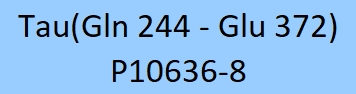
    Human Tau-441 K18 Pre-formed Fibrils Protein, Tag Free (TAU-H5116) is expressed from E. coli cells. It contains AA Gln 244 - Glu 372 (Accession # P10636-8).

    Predicted N-terminus: Met
    Request for sequence
  • Molecular Characterization

    Tau Structure

    Other Tags and Version Biotin & Other Labeled Version

    This protein carries no "tag".

    The protein has a calculated MW of 13.8 kDa.

  • Application

    1. Sonication Conditions, Dissolution, Aliquoting, Storage, and Notes for PFF

    Thawing: Thaw PFFs rapidly in a 37 °C water bath, or allow to thaw at room temperature.

    Aliquoting: Since PFFs are supplied as a suspension, pipette up and down thoroughly before aliquoting to ensure homogeneity.

    Storage: Store at -80 °C at all times; avoid storage at 4 °C or -20 °C, which can induce fibril depolymerization. * α-Syn fibrils cold-denatured to monomers at 0-20 °C and heat-denatured at 60-110 °C.

    Sonication: The sonication protocols below are based on cell-based assay conditions.

    -Option 1 (Probe Sonicator): Use a probe sonicator (SCIENTZ) at 10% power (-95 W), applying 60 pulses of 0.5 s on/0.5 s off (recommended).

    -Option 2 (Ultrasonic Bath): Sonicate in an ultrasonic cleaner (40 kHz, 200-400 W) at 37 °C for 1 hour; avoid performing the treatment at 4 °C or 20 °C.

    Note: The above sonication protocols are based on cell-based assays; other applications (e.g., in vivo injections) may require optimization-users should determine their optimal settings for their specific use case.

    2. Recommendations for PFF Use in Animal Models

    Minimize Freeze-Thaw Cycles: For animal studies, it is recommend to use the PFF at once or aliquot before use to avoid repeated freeze-thaw cycles.

    PFF Maintenance During Injections: During stereotaxic injections, keep the sonicated PFFs in a 37 °C water bath to prevent re-aggregation or sedimentation.

  • Endotoxin

    Less than 1.0 EU per μg by the LAL method / rFC method.

  • Purity

    >90% as determined by SDS-PAGE.

  • Formulation

    Supplied as 0.2 μm filtered solution in PBS, pH7.4.

    Contact us for customized product form or formulation.

  • Shipping

    This product is supplied and shipped with dry ice, please inquire the shipping cost.

  • Storage

    Please avoid repeated freeze-thaw cycles.

    This product is stable after storage at:

    1. The product should be stored at -70°C or room temperature for short storage. Do not store fibrils on ice or at 4°C;
    2. The unsonicated fibril is validated to be stable after storage at -70°C for 1 year under sterile conditions;
    3. The sonicated fibril should be stored at -70°C for not more than 8 weeks.
  • ACRO Quality Management System

    1. QMS(ISO, GMP)
    2. Quality Advantages
    3. Quality Control Process

Customers Also Viewed

Performance Data

  • SDS-PAGE

    Tau SDS-PAGE

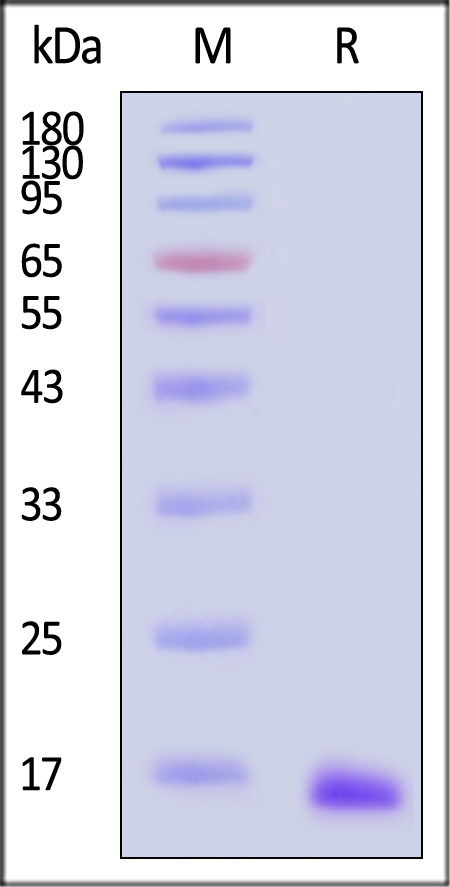
    Tau-441 K18 monomer on SDS-PAGE under reducing (R) condition. The gel was stained overnight with Coomassie Blue. The purity of the protein is greater than 90% (With Star Ribbon Pre-stained Protein Marker).

  • Electron Microscope

     Tau ELECTRON MICROSCOPE

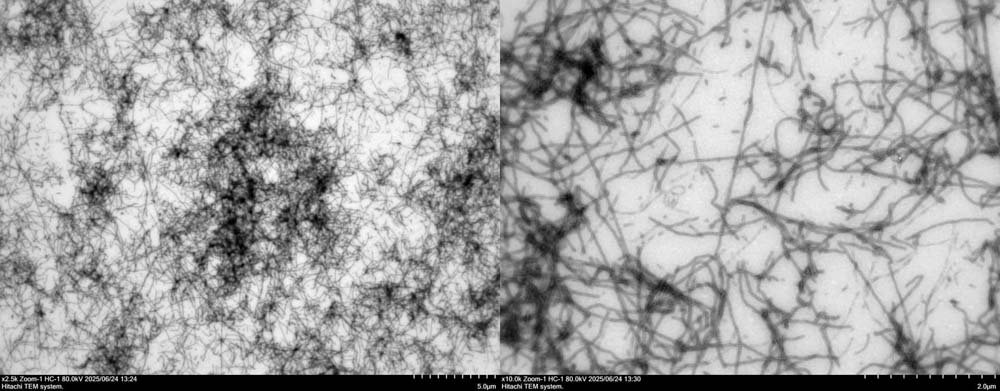
    Transmission electron microscopy (TEM) of Human Tau-441 K18 Pre-formed Fibrils Protein, Tag Free (Cat. No. TAU-H5116). Fibril structure is visible on negative stain TEM images of TAU-H5116.

  • Application Data

     Tau APPLICATION DATA

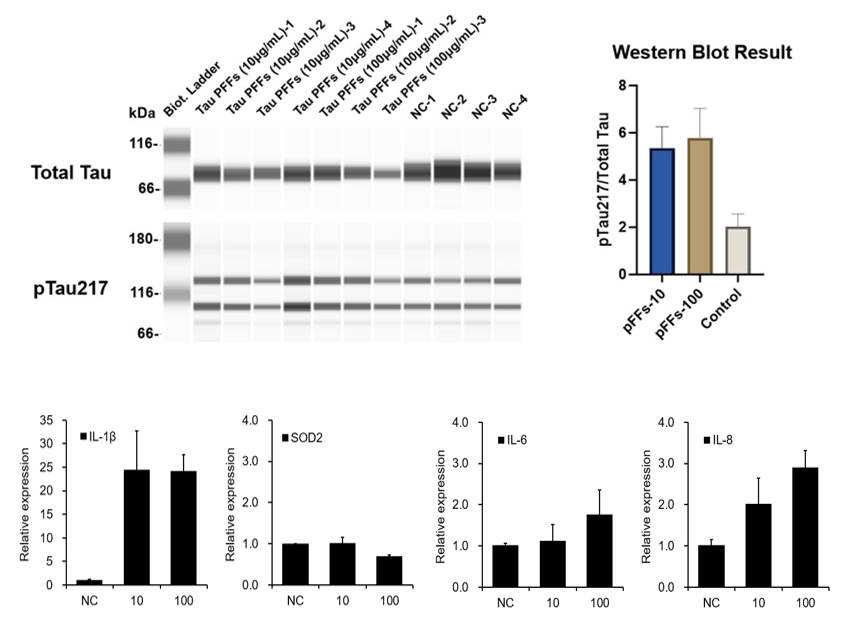
    In brain organoids (CIPO-BWL002K), Human Tau-441 K18 Pre-formed Fibrils Protein, Tag Free (Cat. No. TAU-H5116) dose-dependently upregulate IL-1β, IL-6 and IL-8, increase the tau phosphorylation at Thr217 and suppress SOD2, indicating that PFF treatment induces tau phosphorylation, neuroinflammation and disrupts antioxidant balance.​

Customer Reviews
Writing Reviews

Background

Tau is a microtubule-associated protein, which encodes by the MAPT gene that located on chromosome 17q21. Tau Promotes microtubule assembly and stability, and might be involved in the establishment and maintenance of neuronal polarity. Hyperphosphorylation of the tau protein (tau inclusions, pTau) can result in the self-assembly of tangles of paired helical filaments and straight filaments, which are involved in the pathogenesis of Alzheimer's disease, frontotemporal dementia, and other tauopathies.

Recent Advances

 
Drug Development Progress
  • English Name:

    Microtubule-associated protein tau

  • Category:

  • Approved Drugs:

    1 Details

  • Drugs in Clinical Trials:

    46 Details

  • Highest Development Stage:

    Approved

Contact Us
Drug Candidate Licensing
More
  • Basic Product Information
  • Product Details
  • Customers Also Viewed
  • Performance Data
  • Customer Reviews
  • Background
Contact Us

[North America]: +1 800-810-0816
[Switzerland]: +41 800 040 012
[Asia & Pacific]: +86 400-682-2521

[North America]: 1 Innovation Way, Newark, DE 19711, USA
[Switzerland]: ACRObiosystems AG, c/o Zug Dammstrasse Centre AG, Dammstrasse 19, 6300 Zug Switzerland