



Overview
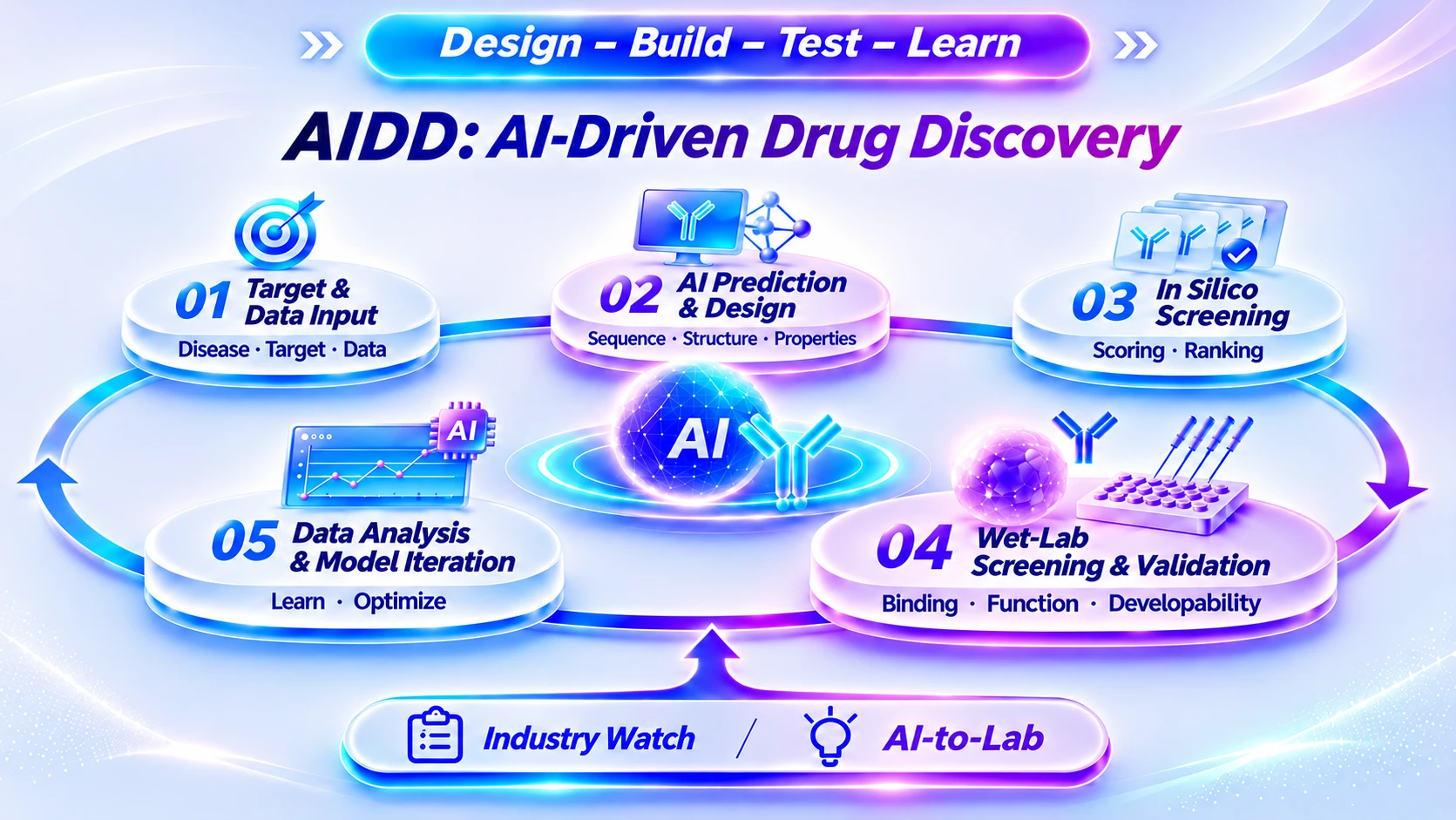
Artificial intelligence (AI) is transforming drug discovery. In AI-driven drug discovery (AIDD), researchers leverage AI to identify targets, design drug candidates, and optimize molecular properties. Wet-lab screening and validation helps assess biological activity, verify AI predictions, and guide further development.
ACROBiosystems’ AIDD-Ready Platform, featuring extensive research resources and CHO-Direct™ screening and validation service, supports experimental validation and high-quality data generation for better R&D decisions and AI model iteration.
Explore innovative perspectives on AIDD below: Industry Watch and AI-to-Lab Design Notes.
Explore by Subtopics

No results found
Get ACRO Insights in Your Inbox
Receive expert perspectives, research trends, and workflow guidance across emerging therapeutic fields.
Get ACRO Insights in Your Inbox
Frequently Asked Questions
What is the current state of AI-driven drug discovery (AIDD), and how far have its drug candidates progressed in clinical development?
As of November 2026, most AI-driven drug discovery (AIDD) programs remain in discovery or preclinical development. Most candidates that have entered clinical trials are in Phase I or II, and the most advanced have reached Phase III. Progress depends on connecting AI predictions with wet-lab experiments. Testing establishes whether candidates bind their targets and produce the intended biological effects, while experimental feedback guides further design and model iteration.
How can researchers evaluate an AI model for a drug discovery program?
First, test its predictions prospectively on targets and candidates relevant to the program. Then define success criteria before testing and compare results with an appropriate baseline under the same experimental conditions and budget. Finally, assess whether the model improves a meaningful outcome, such as confirmed hit rate or candidate quality.
How can AI-designed antibodies be experimentally validated?
AI-designed antibodies can be evaluated through a series of experimental assays, including binding affinity and specificity assessment, epitope characterization, cell-based functional assays, and developability analysis. Techniques such as SPR/BLI, flow cytometry, and reporter assays help verify target binding and biological activity, while stability, aggregation, and expression assessments provide insights for developability. Together, these evaluations generate experimental evidence to support candidate selection and AI model iteration.
What are the key challenges in advancing AI-designed drug candidates to clinical trials?
Key challenges include demonstrating activity in relevant biological systems, achieving adequate exposure, establishing an acceptable safety profile, and manufacturing material of consistent quality. Candidates also need a preclinical evidence package that supports human testing. Priorities vary by modality, mechanism, and intended clinical use.