



Inhibitor Screening Kits
Inhibitor screening plays a crucial role in drug development, particularly in the early stages. The process involves screening a large number of candidate molecules to identify those with notable pharmacological effects, which are then further evaluated. To efficiently screen multiple potential inhibitors, rapid and sensitive tools are required.
To efficiently screen multiple potential inhibitors by developing an inhibitor screening platform based on the competitive ELISA method. We offer a series of high-sensitivity inhibitor screening kits that utilize unique in-house biotinylated proteins. These kits are designed for preliminary screening and quality control in drug development, providing researchers with reliable, efficient, and accurate tools for inhibitor screening.
Product Features
 Accurate & Reliable: Verified raw materials with high batch-to-batch consistency ensure stable and reliable experimental results.
Easy-to-use & Time-saving: Simple, 4-step ELISA procedure has been pre-validated to eliminate time-consuming method development and validations.
Minimal Matrix Effects: Interfering substances, including DMSO, were studied to ensure kit compatibility with small and macro-molecule inhibitors.
High Repeatability: Kits are highly stable and have minimal lot-to-lot variation and use our site-specific biotin labeling platform.
Overview
| Quantity | 96 tests | |
| Detection Method | Colorimetric | |
| Method Type | Competitive ELISA | |
| Applications | High-throughput screening antibodies, small molecule inhibitors, peptide, etc. | |
Schematic Diagram

Notes: The assay employs a simple colorimetric ELISA platform which is based on the competitive binding technique. (The principles between different inhibitor screening kits are slightly different)
The experimental protocol includes 4 short steps:
-
Coat the plate with human PD-L1.
-
Add Human PD-1-Biotin to bind the coated human PD-L1.
-
Add your molecule of interest to the tests.
-
Add Streptavidin-HRP followed by TMB or other colorimetric HRP substrate.
Finally, the ability of your compound to inhibit PD-1: PD-L1 binding will be determined by comparing OD readings among different experimental groups.
Components
Take PD-1 [Biotinylated] : PD-L1 Inhibitor Screening ELISA Kit (EP-101) for example.
| ID | Components | Size |
|---|---|---|
| EP101-C01 | High-bind Plate | 1 plate |
| EP101-C02 | Human PD-L1 | 25 μg |
| EP101-C03 | Anti-PD-1 Neutralizing Antibody | 20 μg |
| EP101-C04 | Human PD-1-Biotin | 5 μg |
| EP101-C05 | Streptavidin-HRP | 10 μg |
| EP101-C06 | Coating Buffer | 12 mL |
| EP101-C07 | 10xWashing Buffer | 50 mL |
| EP101-C08 | Blocking Buffer | 50 mL |
| EP101-C09 | Substrate Solution | 12 mL |
| EP101-C10 | Stop Solution | 7 mL |
Product List
| Cat. No. | Molecule | Product Description | Order Now |
|---|---|---|---|
 Order | |||
| Order | |||
| Order | |||
| Order | |||
| Order | |||
| Order | |||
| Order | |||
| Order | |||
| Order | |||
| Order | |||
| Order | |||
| Order | |||
| Order | |||
| Order | |||
| Order | |||
| Order | |||
| Order | |||
| Order | |||
| Order | |||
| Order | |||
| Order | |||
| Order | |||
| Order | |||
| Order | |||
| Order | |||
| Order | |||
| Order | |||
| Order | |||
| Order | |||
| Order | |||
| Order | |||
| Order | |||
| Order | |||
| Order | |||
| Order | |||
| Order | |||
| Order | |||
| Order | |||
| Order | |||
| Order | |||
| Order | |||
| Order | |||
| Order | |||
| Order | |||
| Order | |||
| Order | |||
| Order | |||
| Order | |||
| Order | |||
| Order | |||
| Order | |||
| Order | |||
| Order | |||
| Order | |||
| Order | |||
| Order | |||
| Order | |||
| Order | |||
| Order | |||
| Order | |||
| Order | |||
| Order | |||
| Order | |||
| Order | |||
| Order |
Supplement Data
Inhibition of PD-1: PD-L1 binding by anti-PD-1 neutralizing antibody measured using the PD-1 [biotinylated]: PD-L1 inhibitor screening ELISA assay pair (Cat. No. EP-101).

Anti-PD-1 neutralizing antibody was diluted from 10 μg/mL to 0.078 μg/ mL (69.628 nM to 0.544 nM) and loaded onto the plate coated by human PD-L1 in the presence of human PD-1-Biotin. Assay was performed according to the protocol in PD-1[Biotinylated] : PD-L1 Inhibitor Screening ELISA Assay Pair. Background was subtracted from data points prior to log transformation and curve fitting (QC tested).
Inhibition of TL1A [Biotinylated] : DR3 binding by anti-TL1A neutralizing antibody measured using TL1A [Biotinylated] : DR3 inhibitor screening kit (Cat. No. EP-168)
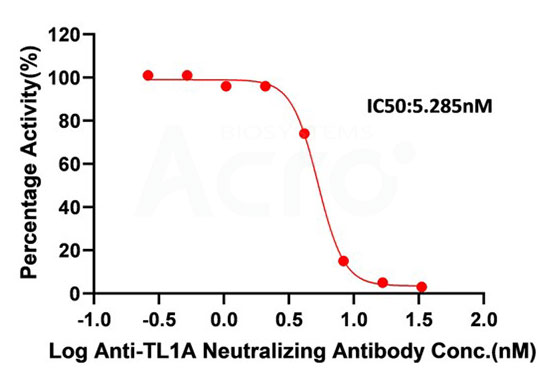
Serial dilutions of Human Anti-TL1A Neutralizing antibody (Catalog # EP168-C04) (1:1 serial dilution, from 5 μg/mL to0.0390625 μg/mL) was added into Human DR3: Biotinylated Human TL1A binding reactions. The assay was performed according to the protocol described below. Background was subtracted from data points prior to log transformation and curve fitting (QC tested). For each experiment, a standard curve needs to be set for each micro-plate, and the specific OD value may vary depending on different laboratories, testers, or equipments. The example data is for reference only.
Inhibition of IL-4: IL-4 R alpha binding by Human IL-4 measured using IL-4 [biotinylated]: IL-4 R alpha inhibitor screening kit (Cat. No. EP-132).

Serial dilutions of Human IL-4(Catalog # EP132-C03) (1:1 serial dilution, from 5 μg/mL to 0.01 μg/mL (295.86-0.58 nM)) was added into IL-4 R alpha: IL-4-Biotin binding reactions. The assay was performed according to the above-described protocol. Background was subtracted from data points prior to log transformation and curve fitting (QC tested).
Inhibition of Integrin α 4 β 7: MAdCAM-1binding by anti-Integrin α 4 β 7 neutralizing antibody measured using Integrin α 4 β 7: MAdCAM-1 [Biotinylated] inhibitor screening kit (Cat. No. EP-155)

Serial dilutions of Anti-Integrin α 4 β 7 Neutralizing antibody (Catalog # EP155-C04) (1:1 serial dilution, from 5 μg/mL to 0.0098μg/mL) was added into Integrin α 4 β 7: Biotinylated MAdCAM-1 binding reactions. The assay was performed according to the protocol described below. Background was subtracted from data points prior to log transformation and curve fitting (QC tested).
Related product


FAQ
What types of inhibitors can be evaluated with these screening kits?
Which assay formats are available for inhibitor screening?
How does the competitive ELISA inhibition format work?
What assay considerations differ when screening therapeutic antibodies, peptides, and small-molecule PPI inhibitors?
How can the inhibitory profiles of antibodies targeting multiple ligand–receptor interactions be characterized?
What performance data should be considered when selecting an inhibitor screening kit for reproducible candidate evaluation?
Which therapeutic pathways and target interactions can be evaluated using ACROBiosystems inhibitor screening kits?
- Background
- Product Features
- Overview
- Schematic Diagram
- Components
- Product List
- Supplement Data
- Related product
- FAQ