Save Product

Product Details
Source
Monoclonal Anti-Nipah Post Fusion glycoprotein Antibody, Human IgG1 (3C3) is a chimeric monoclonal antibody recombinantly expressed in HEK293, which combines the variable region of a mouse monoclonal antibody with human constant domain.
Antibody Type
Recombinant Monoclonal
Clone
3C3
Isotype
Human IgG1, Kappa
Host Species
Mouse
Specificity
This product is a specific antibody specifically reacts with Nipah Post Fusion glycoprotein.
Application
ApplicationRecommended UsageWestern Blot0.05-10 ug/mLPurification
Protein A purified / Protein G purified.
Aggregation
Less than 10%, as determined by SEC-MALS.
Concentration
Please refer to the Certificate of Analysis (CoA).
Form
Lyophilized
Formulation
Lyophilized from a 0.22 μm-filtered solution in PBS (pH 7.4), with trehalose as protectant.
Please contact us for customized product forms or formulations.
Reconstitution
Please refer to the Certificate of Analysis (CoA) for specific instructions.
Shipping
Lyophilized product is shipped at ambient temperature.
Storage
For long term storage, the product should be stored in a lyophilized state at -20°C or lower.
Please avoid repeated freeze-thaw cycles.
This product is stable after storage at:
- -20°C to -70°C for 12 months in lyophilized state;
- -70°C for 3 months under sterile conditions after reconstitution.
Notices
Product Specific Notices: For research use only.
ACRO Quality Management System
Customers Also Viewed
Performance Data
Bioactivity-ELISA
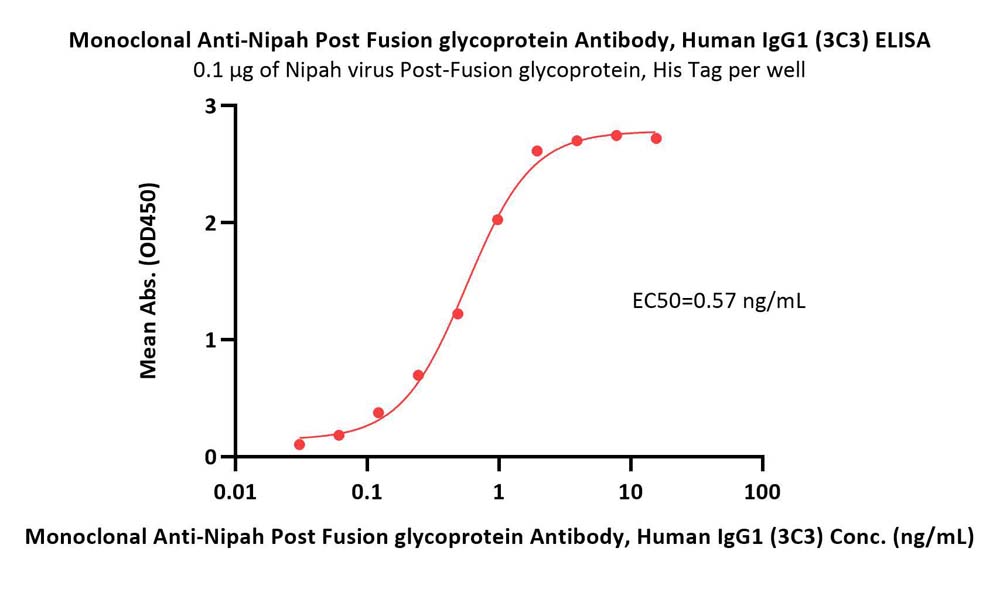
Immobilized Nipah virus Post-Fusion glycoprotein, His Tag (Cat. No. PON-V52H3) at 1 μg/mL (100 μL/well) can bind Monoclonal Anti-Nipah Post Fusion glycoprotein Antibody, Human IgG1 (3C3) (Cat. No. NIN-M760) with a linear range of 0.03-1 ng/mL (QC tested).
Protocol
Bioactivity-SPR
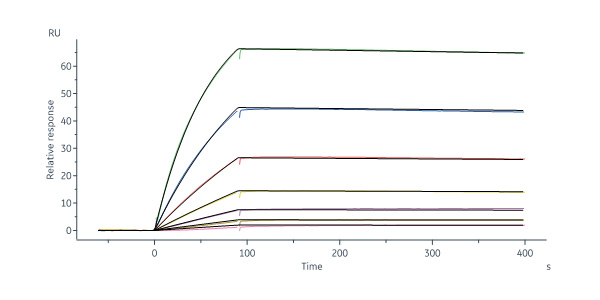
Monoclonal Anti-Nipah Post Fusion glycoprotein Antibody, Human IgG1 (3C3) (Cat. No. NIN-M760) captured on Protein A Chip can bind Nipah virus Post-Fusion glycoprotein, His Tag (Cat. No. PON-V52H3) with an affinity constant of 0.937 nM as determined in a SPR assay (Biacore 8K) (Routinely tested).
Protocol
Customer Reviews Writing Reviews

FAQ
- Product
What do “pre” and “post” refer to in the names of viral proteins?
In virology, “pre” refers to the conformation of a viral surface glycoprotein before fusion with the host cell membrane, while “post” refers to the conformation after membrane fusion and entry into the host cell. Both are naturally occurring states in the viral life cycle. Because the “pre” conformation represents a critical stage before viral entry, antibodies designed against this state often exhibit stronger neutralizing activity and are therefore more effective in preventing infection.
Background
Recent Advances
 Contact Us

[North America]: +1 800-810-0816
[Switzerland]: +41 800 040 012
[Asia & Pacific]: +86 400-682-2521
 Drug Candidate Licensing