Save Product

Product Details
- ProductSizeAmountActiveMax® Human DLL4 μBeads, premium grade (for cells)2.5 mg2.5×10⁷ beadsActiveMax® Human DLL4 μBeads, premium grade (for cells)10 mg1×10⁸ beads
Product Description
ActiveMax® Human DLL4 μBeads, premium grade (for cells) are uniform, superparamagnetic beads of 5.5 µm in diameter immobilized with Human DLL4 Protein, expressed from human 293 cells (HEK293) and contains AA Ser 27 - Pro 524 (Accession # NP_061947.1 ).
ActiveMax® Human DLL4 μBeads, premium grade (for cells) are produced under sterile manufacturing conditions (ISO 5) , and no animal- or human-derived components are used throughout the production process. It is produced under our rigorous quality control system that includes a comprehensive set of tests including sterility and endotoxin tests.Application
ActiveMax® Human DLL4 μBeads, premium grade (for cells) can activate Notch signaling in hematopoietic stem/progenitor cells (HSPCs), mimicking DLL4+ epithelial cells in the thymus, and then drives T-lineage commitment and differentiation. It can be used for in vitro production of induced pluripotent stem cell derived T cells, such as inducing the differentiation from CD34+ cells to progenitor T cells to TCRαβ T cells in vitro, which provides a simple and robust tool to both study human T cell development and facilitate the development of engineered T cell therapies from renewable sources.
Reconstitution
See Certificate of Analysis (CoA) for detailed instruction.
Storage
This product is stable in storage under the following conditions: -20˚C for 12 months in lyophilized state. -70°C for 3 months under sterile conditions after reconstitution.
Please protect from light and avoid repeated freeze-thaw cycles. Immediate use after reconstitution is highly recommended.
Sterility
Negative
Endotoxin
Less than 0.002 EU per μg by the LAL method / rFC method.
Mycoplasma
Negative
Important Note
This product is for research use only and not intended for therapeutic or in vivo diagnostic use.
Formulation
Lyophilized in PBS with 0.1% HSA,pH 7.4. Trehalose is added as protectant before lyophilization.
ACRO Quality Management System
Customers Also Viewed
Performance Data
FACS Data

Assay of human DLL4 protein on the μBeads surface by Flow cytometry.The human DLL4 conjugated on the μBeads (Cat. No. MBS-C013) surface were fluorescently stained using Human Anti-DLL4 Antibody, Mouse IgG1 and PE labeled anti-Mouse IgG1 Antibody, analyzed by flow cytometry (QC tested).
Protocol
Application Data
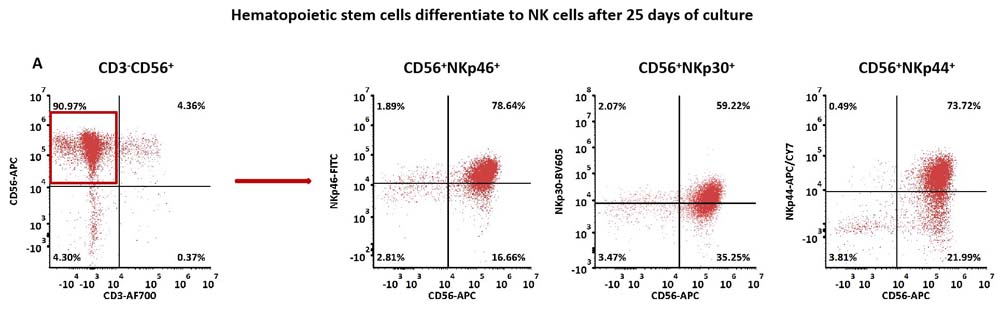
ActiveMax® Human DLL4 μBeads, premium grade (for cells) (Cat. No. MBS-C013) could efficiently induce hematopoietic stem cell differentiation into CD56+ NK cells after 25 days of culture, with high expression of CD56, NKp46, NKp30, and NKp44.
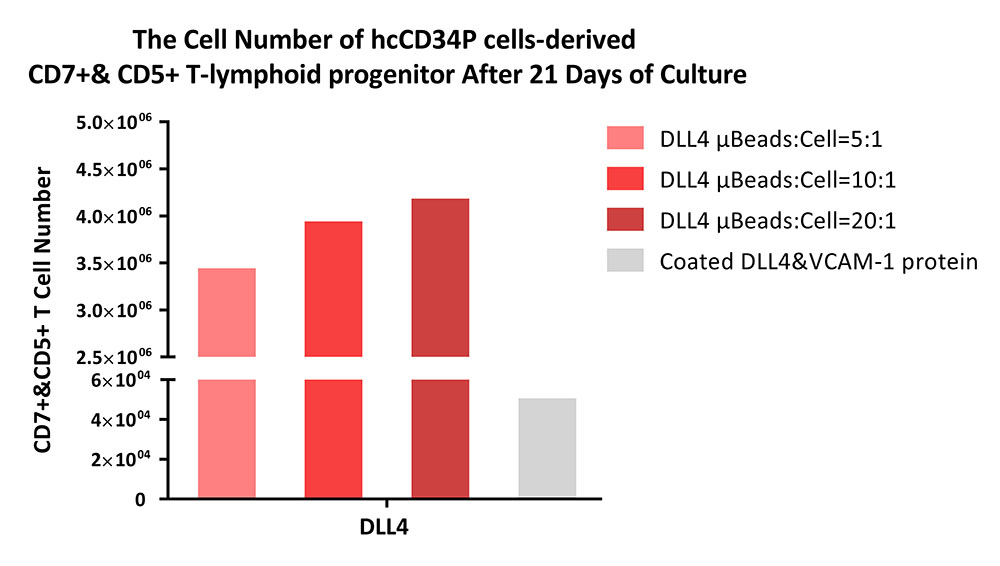
The Cell Number of hcCD34P cells-derived CD7+ and CD5+ T-lymphoid progenitors After 21 Days of Culture. Combinations of ActiveMax® Human DLL4 μBeads, premium grade(for cells)(Cat.No.MBS-C013) and Cytokine could efficiently induce hcCD34P cells differentiation into CD7+ and CD5+ T-lymphoid progenitors after 21 days of culture.
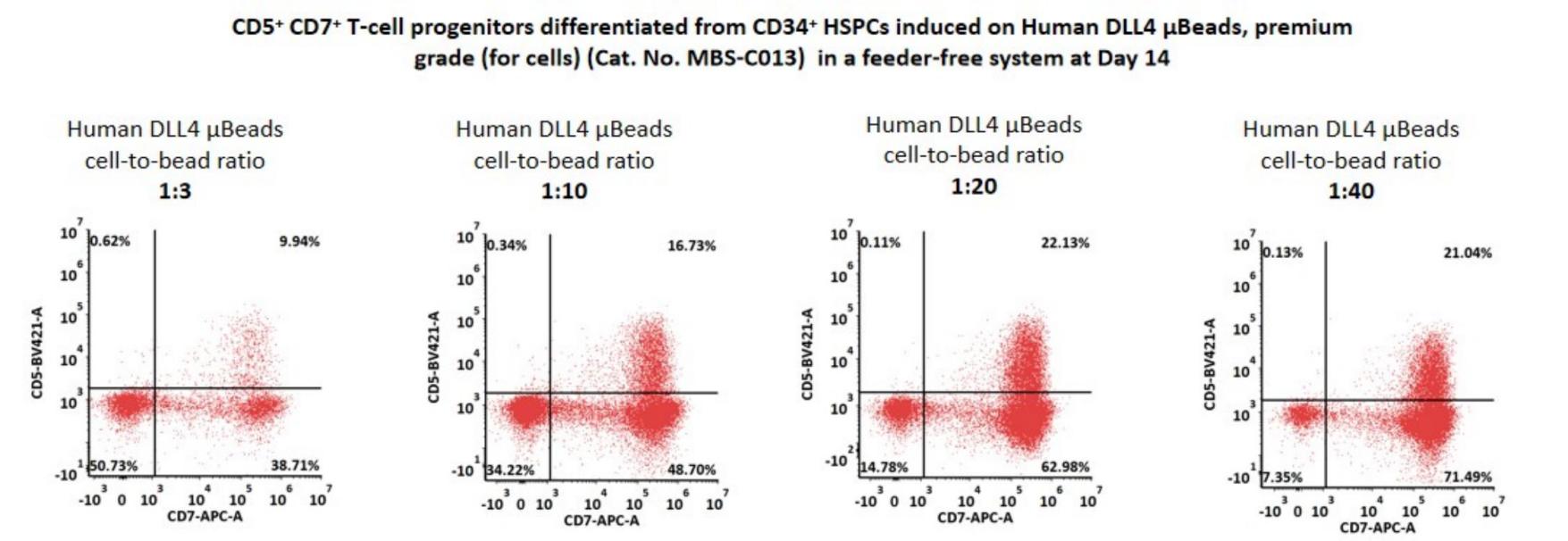
CD34+ CD45+ hematopoietic cells were co-cultured with Human DLL4 μBeads (Cat. No. MBS-C013) and differentiated over a 14-day period. Subsequent flow cytometric analysis was performed to evaluate the expression of T-cell progenitor markers CD5 and CD7. The results indicated that Human DLL4 μBeads (Cat. No. MBS-C013), in combination with supplementary growth factors, effectively promoted the differentiation of CD7+ cells as well as CD5+CD7+ double-positive T-cell progenitors. The induction efficiency was enhanced as the cell-to-bead ratio increased from 1:3 to 1:40. Based on both induction performance and cost-effectiveness, a cell-to-bead ratio of approximately 1:20 is recommended.
Customer Reviews Writing Reviews

Recent Advances
 Drug Development Progress
- English Name:
Delta-like protein 4
- Category:
- Approved Drugs:
0 Details
- Drugs in Clinical Trials:
3 Details
- Highest Development Stage:
Phase 3 Clinical
 Contact Us

[North America]: +1 800-810-0816
[Switzerland]: +41 800 040 012
[Asia & Pacific]: +86 400-682-2521
 Drug Candidate Licensing