Save Product

Product Details
Synonyms
CAIX, CA9, CA-IX, G250, MN, P54, 58N, pMW1
Source
FITC-Labeled Human Carbonic Anhydrase IX (38-414), His Tag (CA9-HF228) is expressed from human 293 cells (HEK293). It contains AA 38 Gln - 414 Asp (Accession # Q16790-1). It is the FITC labeled form of Human Carbonic Anhydrase IX (38-414), His Tag (Cat. No. CA9-H5226).
Predicted N-terminus: 38 Gln
Request for sequenceMolecular Characterization

Other Tags and Version Biotin & Other Labeled Version
This protein carries a polyhistidine tag at the C-terminus.
The protein has a calculated MW of 41.8 kDa. The protein migrates as 43-55 kDa when calibrated against Star Ribbon Pre-stained Protein Marker under reducing (R) condition (SDS-PAGE) due to glycosylation.
The protein is designed as a dimer.
Conjugate
FITC
Excitation source: 488 nm spectral line, argon-ion laser
Excitation Wavelength: 488 nm
Emission Wavelength: 535 nm
Labeling
The primary amines in the side chains of lysine residues and the N-terminus of the protein are conjugated with FITC using standard chemical labeling method. The residual FITC is removed by molecular sieve treatment during purification process.
Protein Ratio
The FITC to protein molar ratio is 0.5-2.
Purity
>90% as determined by SDS-PAGE.
Formulation
Lyophilized from 0.22 μm filtered solution in PBS, pH7.4 with trehalose as protectant.
Contact us for customized product form or formulation.
Reconstitution
Please see Certificate of Analysis for specific instructions.
For best performance, we strongly recommend you to follow the reconstitution protocol provided in the CoA.
Storage
For long term storage, the product should be stored at lyophilized state at -20°C or lower.
Please protect from light and avoid repeated freeze-thaw cycles.
This product is stable after storage at:
- -20°C to -70°C for 12 months in lyophilized state;
- -70°C for 3 months under sterile conditions after reconstitution.
ACRO Quality Management System
Customers Also Viewed
Performance Data
SDS-PAGE

FITC-Labeled Human Carbonic Anhydrase IX (38-414), His Tag on SDS-PAGE under reducing (R) condition. The gel was stained with Coomassie Blue. The purity of the protein is greater than 90% (With Star Ribbon Pre-stained Protein Marker).
SEC-MALS
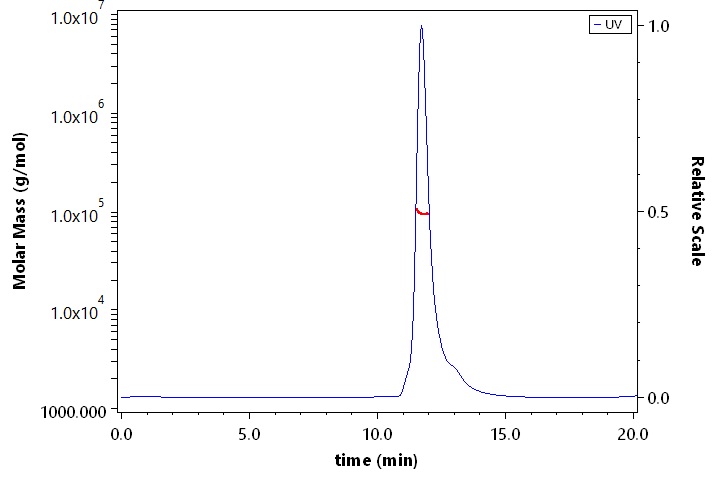
The purity of FITC-Labeled Human Carbonic Anhydrase IX (38-414), His Tag (Cat. No. CA9-HF228) is more than 85% and the molecular weight of this protein is around 80-110 kDa verified by SEC-MALS.
Report
Bioactivity-ELISA

Immobilized Anti-Carbonic Anhydrase IX Antibody, Human IgG1 at 1 μg/mL (100 μL/well) can bind FITC-Labeled Human Carbonic Anhydrase IX (38-414), His Tag (Cat. No. CA9-HF228) with a linear range of 0.01-1.25 μg/mL (QC tested).
Protocol
Bioactivity-FACS

2e5 of Anti-Carbonic Anhydrase IX CAR-293 cells were stained with 100 μL of 3 μg/mL of FITC-Labeled Human Carbonic Anhydrase IX (38-414), His Tag (Cat. No. CA9-HF228) and negative control protein respectively. FITC signal was used to evaluate the binding activity (QC tested).
Protocol
Customer Reviews Writing Reviews

Background
Carbonic anhydrase 9 (CA9 / CAIX) is also known as Membrane antigen MN (MN), Renal cell carcinoma-associated antigen G250, which belongs to the alpha-carbonic anhydrase family. CA9 / CAIX with an optimal activity at pH 6.49. Reversible hydration of carbon dioxide. CA IX participates in pH regulation. CA9 may be involved in the control of cell proliferation and transformation. CA-IX appears to be a novel specific biomarker for a cervical neoplasia.
Recent Advances
 Drug Development Progress
- English Name:
Carbonic anhydrase IX
- Category:
- Approved Drugs:
0 Details
- Drugs in Clinical Trials:
16 Details
- Highest Development Stage:
Phase 3 Clinical
 Contact Us

[North America]: +1 800-810-0816
[Switzerland]: +41 800 040 012
[Asia & Pacific]: +86 400-682-2521
 Drug Candidate Licensing