Jul 27, 2026
 Page Views:197


Sterility testing is one of the most critical quality control (QC) procedures in biopharmaceutical manufacturing and a prerequisite for product release. Sterile products—including vaccines, recombinant proteins, monoclonal antibodies, cell therapies, and gene therapies—must be demonstrated to be free of viable microbial contamination before they can be released for clinical or commercial use. Any microbial contamination introduced during manufacturing may compromise product quality, reduce therapeutic efficacy, or pose serious risks to patient safety. Therefore, establishing a reliable, compliant, and efficient sterility testing strategy is essential for ensuring product quality, regulatory compliance, and manufacturing efficiency.
With the rapid growth of advanced therapies such as cell and gene therapy (CGT), conventional sterility testing has become increasingly challenging due to its lengthy turnaround time. Rapid Microbiological Methods (RMMs), particularly qPCR-based nucleic acid amplification technologies (NAT), are emerging as promising alternatives that significantly shorten testing time while maintaining analytical performance.
Why Is Sterility Testing So Important?
Unlike terminally sterilized products, many biologics are manufactured aseptically and cannot undergo terminal sterilization without affecting product quality. As a result, microbial contamination introduced at any stage of manufacturing—from raw materials and cell banks to intermediates and finished products—can directly impact product safety. Sterility testing therefore serves as a critical component of microbial contamination control throughout the manufacturing process.
For biopharmaceutical manufacturers, sterility testing directly impacts:
- ✔ Product quality and patient safety
- ✔ GMP compliance
- ✔ Regulatory submissions and product release
- ✔ Manufacturing efficiency and supply chain management
The need for rapid sterility testing is especially critical for advanced therapies such as CAR-T, TCR-T, gene therapies, and stem cell-derived products, many of which have shelf lives measured in only a few days.
Global Regulatory Requirements for Sterility Testing
Major pharmacopoeias provide harmonized requirements for sterility testing, including:
- ✔ USP <71> Sterility Tests
- ✔ European Pharmacopoeia (EP) Chapter 2.6.1 Sterility
- ✔ Chinese Pharmacopoeia (ChP) Sterility Test
- ✔ Japanese Pharmacopoeia (JP) Sterility Test
These compendial methods require sterile products to demonstrate the absence of viable microorganisms using validated testing procedures.
In recent years, regulatory agencies have also encouraged the adoption of Rapid Microbiological Methods (RMMs). Guidance documents such as:
- ✔ USP <1223> Validation of Alternative Microbiological Methods
- ✔ European Pharmacopoeia Chapter 5.1.6 Alternative Methods for Control of Microbiological Quality
describe the validation principles for demonstrating equivalence between alternative methods and conventional compendial methods. Once appropriately validated, rapid sterility testing methods may be implemented as compliant alternatives within GMP quality systems.
How Does Conventional Sterility Testing Work?
The conventional compendial sterility test is based on microbial culture. Samples are inoculated into specified culture media and incubated under defined conditions. Sterility is determined by observing whether microbial growth occurs during the prescribed incubation period.
Two compendial approaches are commonly used:
- ✔ Membrane filtration
- ✔ Direct inoculation
Because the method relies on microbial growth, incubation typically lasts up to 14 days.
Although conventional culture methods are well established and globally accepted, they present several limitations:
- ✔ Long turnaround time delays batch release
- ✔ Unsuitable for short shelf-life products
- ✔ Labor-intensive workflows
- ✔ Limited capability for real-time process monitoring
- ✔ Late detection of contamination may result in significant manufacturing losses
These limitations have become increasingly significant as advanced biologics continue to expand.
Rapid Sterility Testing Technologies
Rapid Microbiological Methods (RMMs) have evolved considerably over the past decade. Several technologies are currently used for rapid sterility testing.
1. qPCR-Based Nucleic Acid Amplification Technology (NAT)
qPCR detects microbial DNA or RNA directly through nucleic acid amplification without requiring microbial cultivation. Key advantages include:
- ✔ Rapid turnaround time
- ✔ High analytical sensitivity
- ✔ Excellent automation compatibility
- ✔ Suitable for complex biological matrices
Today, qPCR has become one of the most widely adopted rapid sterility testing technologies.
2. ATP Bioluminescence
ATP bioluminescence measures intracellular ATP to indicate microbial presence. Although rapid, its performance may be affected by sample background and matrix interference.
3. Flow Cytometry
Flow cytometry combines fluorescent staining with cell counting technologies to detect viable microorganisms. The method offers rapid analysis but requires specialized instrumentation and expertise.
4. Rapid Culture-Based Technologies
Automated imaging systems accelerate microbial detection by monitoring early microbial growth. While faster than traditional culture methods, these techniques still rely on microbial cultivation.
Among current RMM technologies, qPCR provides one of the best combinations of speed, sensitivity, and automation capability for biopharmaceutical manufacturing.
Advantages of qPCR-Based Rapid Sterility Testing
Quantitative PCR (qPCR) employs sequence-specific primers and fluorescent probes to amplify microbial nucleic acids in real time, enabling rapid detection without waiting for microbial growth. Compared with conventional sterility testing, qPCR offers several important advantages.
1. Significantly Shorter Turnaround Time
Traditional sterility testing requires up to 14 days of incubation, whereas qPCR-based workflows can generate results in approximately three hours, dramatically accelerating batch release.
2. High Sensitivity and Multiplex Detection
qPCR can detect extremely low levels of microbial nucleic acids while simultaneously detecting bacterial and fungal targets through multiplex fluorescence assays.
3. Automation-Friendly Workflow
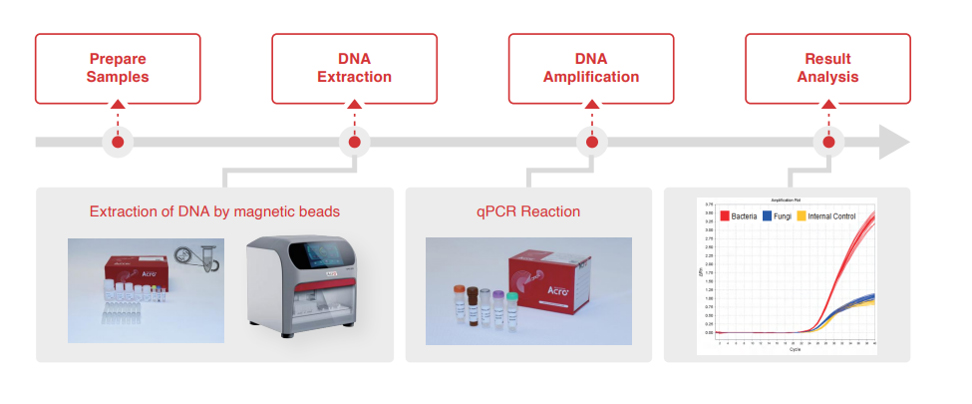
When integrated with magnetic bead-based nucleic acid extraction and automated extraction platforms, qPCR minimizes manual intervention, improves reproducibility, and supports high-throughput GMP laboratories.
4. Supports End-to-End Quality Control
Rapid sterility testing can be applied throughout biopharmaceutical manufacturing, including:
- ✔ Raw material testing
- ✔ Cell bank qualification
- ✔ In-process monitoring
- ✔ Process development
- ✔ Finished product release
- ✔ Environmental monitoring support
This enables earlier detection of contamination and strengthens microbial risk management throughout the manufacturing lifecycle.
Table 1. Comparison of Conventional and qPCR-Based Sterility Testing
| Feature | Conventional Sterility Testing | qPCR-Based Rapid Sterility Testing |
|---|---|---|
| Detection Principle | Microbial culture | Nucleic acid amplification (qPCR) |
| Time to Result | Up to 14 days | Approximately 3 hours |
| Target Detection | Viable microorganisms after growth | Microbial DNA/RNA |
| Bacteria & Fungi Detection | Separate culture conditions | Simultaneous multiplex detection |
| Automation Compatibility | Limited | Highly compatible |
| Process Monitoring | Primarily final product testing | Raw materials, cell banks, intermediates, and finished products |
| Suitability for Short Shelf-Life Products | Limited | Highly suitable |
| Throughput | Relatively low | High-throughput compatible |
As biopharmaceutical manufacturing continues to evolve toward continuous manufacturing, automation, and advanced therapies, quality control is shifting from endpoint testing toward rapid feedback and proactive process monitoring. For products such as CAR-T, TCR-T, iPSC-derived therapies, AAV vectors, and mRNA vaccines, shorter sterility testing turnaround times not only accelerate product release but also reduce inventory costs, improve manufacturing efficiency, and strengthen microbial contamination control. Consequently, more biopharmaceutical companies are evaluating and implementing qPCR-based rapid sterility testing workflows to support future commercial manufacturing.
Conclusion
Sterility testing remains a cornerstone of quality assurance in biopharmaceutical manufacturing. While conventional culture-based methods continue to serve as globally recognized compendial standards, their long incubation period increasingly limits manufacturing efficiency, particularly for advanced therapies with short shelf lives.
qPCR-based rapid sterility testing, built on nucleic acid amplification technology (NAT), offers a powerful alternative by combining rapid turnaround, high sensitivity, automation compatibility, and comprehensive process monitoring capabilities.
As validation strategies continue to mature and regulatory acceptance expands, qPCR-based rapid sterility testing is expected to play an increasingly important role in helping biopharmaceutical manufacturers improve product release efficiency while maintaining the highest standards of quality, safety, and regulatory compliance.
Recommended Solution: SAFENSURE™ Sterility Rapid Detection Kit (qPCR)
As rapid microbiological methods continue to gain acceptance across the biopharmaceutical industry, nucleic acid amplification technologies (NAT), particularly quantitative PCR (qPCR), have become an effective approach for accelerating sterility testing while maintaining high analytical sensitivity.
Following nucleic acid extraction, the SAFENSURE™ Sterility Rapid Detection Kit (OPA-S103) enables rapid detection of bacterial and fungal contaminants using a multiplex qPCR assay. When paired with the SAFENSURE™ DNA Sample Preparation Kit, the complete workflow delivers results in approximately 3 hours, significantly reducing turnaround time compared with conventional culture-based sterility testing.
The integrated solution is well suited for microbial monitoring throughout the biomanufacturing workflow, including:
- ✔ Raw materials and process intermediates
- ✔ Cell banks and cell expansion processes
- ✔ Fill-and-finish operations
- ✔ Final product release testing
- ✔ Environmental and process monitoring
Designed for complex biological matrices, the workflow combines magnetic bead-based DNA extraction with sensitive nucleic acid amplification to support reliable microbial detection while minimizing matrix interference. By enabling earlier identification of contamination events, manufacturers can improve process control, reduce production risks, and accelerate batch release. The SAFENSURE™ workflow is designed to support method validation for rapid sterility testing and can be implemented alongside compendial sterility testing strategies to help manufacturers meet current regulatory expectations while preparing for broader adoption of Rapid Microbiological Methods (RMMs).
FAQ
Q1: What is sterility testing in biopharmaceutical manufacturing?
A: Sterility testing is a quality control procedure used to verify that sterile biopharmaceutical products—including vaccines, monoclonal antibodies, recombinant proteins, cell therapies, and gene therapies—are free of viable microorganisms before release. It is required by global pharmacopoeias such as USP <71>, the European Pharmacopoeia (EP), the Japanese Pharmacopoeia (JP), and the Chinese Pharmacopoeia (ChP).
Q2: What is the difference between conventional sterility testing and qPCR-based rapid sterility testing?
A: Conventional sterility testing relies on microbial culture and typically requires up to 14 days of incubation to detect contamination. In contrast, qPCR-based rapid sterility testing detects microbial DNA or RNA through nucleic acid amplification, delivering results in approximately three hours while offering high sensitivity, automation compatibility, and suitability for products with short shelf lives.
Q3: Why is rapid sterility testing important for cell and gene therapies?
A: Advanced therapies such as CAR-T, TCR-T, gene therapies, and stem cell-derived products often have very limited shelf lives. Rapid sterility testing enables manufacturers to detect microbial contamination much faster than traditional culture methods, helping accelerate batch release, reduce manufacturing delays, and improve patient access while maintaining product quality and regulatory compliance.
Q4: Which regulations govern sterility testing for biopharmaceutical products?
A: Sterility testing is governed by several internationally recognized standards, including USP <71>, European Pharmacopoeia Chapter 2.6.1, Japanese Pharmacopoeia, and Chinese Pharmacopoeia. Alternative rapid methods can be implemented following appropriate validation according to guidance such as USP <1223> and European Pharmacopoeia Chapter 5.1.6.
Q5: When should manufacturers consider adopting qPCR-based rapid sterility testing?
A: Manufacturers should consider qPCR-based rapid sterility testing when working with time-sensitive products, implementing automated GMP workflows, increasing manufacturing throughput, or strengthening in-process microbial monitoring. It is particularly valuable for advanced biologics, continuous manufacturing processes, and quality control strategies that require faster decision-making than conventional culture-based methods can provide.


 Endotoxin Testing for Pharmaceutical and Biologics Quality Control.jpg)