


Solutions for Antibody-Drug Conjugates (ADCs) Development
Antibody Screening
Featured Products for Antibody Drug Screening
- ADC Target Proteins
- ADC Conjugation Kits
ADC Target Proteins
The target antigen expressed on the surface of tumor cells is a key factor for ADCs to recognize tumor cells and guide the cytotoxic payload into the cancer cells. Therefore, selecting an appropriate target antigen is a primary consideration in ADCs design. Ideal antigens should exhibit specific expression, non-secretion, and favorable internalization properties.
We have successfully developed a suite of over 90 high-quality ADCs target proteins, encompassing a variety of species including Human, Mouse, Cynomolgus Monkey, and Rat, each equipped with diverse tags. These proteins with high purity and robust bioactivity, suitable for immunization, Antibody Screening, species validation, quality control, pharmacokinetic studies, and diverse applications.
ADC Conjugation Kits
Developing effective Antibody-Drug Conjugates (ADCs) requires a conjugation method that can precisely and stably link the cytotoxic payload (e.g., MMAE, DXd) to the antibody. This critical choice directly impacts the ADC's efficacy, safety, and manufacturing feasibility.
To meet the demand for efficient and accurate ADC conjugation, we offer a new line of High-Efficiency Conjugation Kits. These kits facilitate rapid screening, yielding ADCs with controllable DAR in under 3 hours. They guarantee high performance, achieving >95% conjugation efficiency and >80% recovery. The resulting ADCs are ideal for rapid in vitro and in vivo evaluation to identify lead candidates.
Furthermore, the AGLink® DAR2&4 Site-Specific Conjugation Kit, developed in collaboration with Glyco-Therapy Biotechnology Co., Ltd., employs the proprietary YTConju™ glycan-based conjugation technology. This “one-pot, one-step” method enables the generation of highly homogeneous ADCs to support early-stage research and biological experiments in ADC field.
- ADC Target Proteins
- ADC Conjugation Kits
ADC Target Proteins
The target antigen expressed on the surface of tumor cells is a key factor for ADCs to recognize tumor cells and guide the cytotoxic payload into the cancer cells. Therefore, selecting an appropriate target antigen is a primary consideration in ADCs design. Ideal antigens should exhibit specific expression, non-secretion, and favorable internalization properties.
We have successfully developed a suite of over 90 high-quality ADCs target proteins, encompassing a variety of species including Human, Mouse, Cynomolgus Monkey, and Rat, each equipped with diverse tags. These proteins with high purity and robust bioactivity, suitable for immunization, Antibody Screening, species validation, quality control, pharmacokinetic studies, and diverse applications.
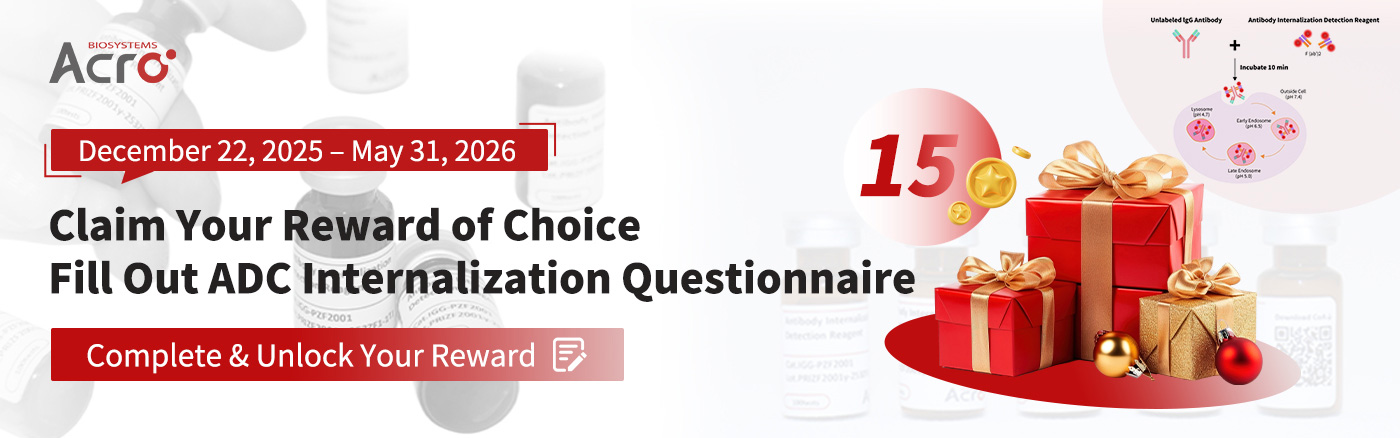
Internalization Analysis for ADC Research
For most conventional ADCs, efficient cellular internalization is a critical step for intracellular payload delivery and therapeutic activity. Quantitative analysis of ADC internalization provides valuable insights for candidate evaluation, mechanism-of-action studies, and lead optimization throughout ADC discovery and preclinical development.
Based on pH-sensitive fluorescent dye technology, the pHintra™ Internalization Solution from ACROBiosystems provides two complementary approaches for ADC internalization analysis: a ready-to-use Fc-binding internalization detection reagent for rapid analysis of human IgG-based ADCs, and a covalent antibody/ADC-labeling kit for pH-sensitive fluorescent labeling through primary amine conjugation and is compatible with antibodies from multiple species and isotypes.
Both approaches are compatible with flow cytometry, high-content imaging, and confocal microscopy, supporting efficient internalization analysis across diverse ADC research workflows—from high-throughput screening to in-depth mechanistic studies.
Fc Effector Function Validation
The efficacy of antibody-drug conjugates (ADCs) is determined not only by the ability of their Fab fragments to bind tumor-associated antigens but also by the interaction between their Fc fragments and Fc receptors. Fc-mediated effector functions—such as antibody-dependent cellular cytotoxicity (ADCC), complement-dependent cytotoxicity (CDC), and antibody-dependent cellular phagocytosis (ADCP)—play a crucial role in the elimination or suppression of tumor cells.
Additionally, the affinity of the Fc fragment for the neonatal Fc receptor (FcRn) is a key predictor of an antibody’s half-life. Therefore, optimizing antibody structures and selecting candidates with ideal Fc receptor affinity are essential strategies in the development of therapeutic antibodies.
We offer a comprehensive collection of Fc receptor products, including FcRn, FcγR, and their commonly studied mutants. Leveraging our extensive protein product resources and activity analysis experience, we can also provide high-quality SPR & BLI affinity testing services upon receiving your sample. To support your research, we also supply all necessary high-quality Fc receptor proteins free of charge for these experiments.
Linker Screening and Validation
In the development of ADCs, the linker structure impacts stability, homogeneity, cytotoxic potency, tolerability, and pharmacokinetics (PK). Therefore, selecting the appropriate linker is crucial for optimizing the therapeutic potential and safety of ADCs.
Linkers are typically classified as cleavable or non-cleavable based on their cleavage mechanism. Current ADCs research primarily focuses on cleavable linkers, with cathepsin-cleavable linkers being the most widely used and extensively studied. Additionally, several other linker-cleaving enzymes are under investigation.
For the screening and validation of linkers for ADCs, we have developed a series of proteases specialized in linker cleavage, encompassing Cathepsin B, Cathepsin L, Cathepsin S, MMP-2, MMP-7, MMP-9, β-glucuronidase, β-galactosidase.
Clinical/Preclinical PK Analysis
ADCs have a more complex structure compared to traditional small molecule drugs and antibody drugs, resulting in higher drug heterogeneity, which makes its PK studies more complex. Analytes for ADCs typically encompass total antibodies (both conjugated and unconjugated with cytotoxic payloads, DAR≥0); conjugated antibodies (antibody conjugated to payload, DAR≥1), the antibody-conjugated drug, free drugs, and their analogs. The quantification of total antibodies and conjugated antibodies commonly employs ELISA (Enzyme-linked Immunosorbent Assay), while the analysis of antibody-conjugated drugs, free drugs, and their metabolites frequently involves LC-MS (Liquid Chromatograph Mass Spectrometer).
To support accurate ADC pharmacokinetic (PK) analysis throughout drug development, ACROBiosystems offers a comprehensive portfolio of products and services for ADC quantification and PK assay development. The portfolio includes high-affinity anti-payload antibodies, intact ADC quantification ELISA kits, anti-idiotypic antibodies, and anti-idiotypic antibody development services.
Supporting both preclinical and clinical studies, these solutions help improve the accuracy and reliability of ADC PK analysis.
Product List
 Order
OrderResources
Webinar playback and appointment
‘ADC Potency Analysis and Quality Control Technology Breakthrough’ Webinar Series
ACROBiosystems proudly presents the flagship 'ADC Potency Analysisand Quality Control Technology Breakthrough' live webinar series. This series will systematicallydeconstruct critical aspects ofADC drug development through five coremodules-from potency analysis to quality control technologiesempowering breakthroughs in ADC therapeutics by overcoming keytechnical bottlenecks.

Addressing Challenges in Antibody-Drug Conjugate Development
Here is the brief recap of the webinar:ADCs have the potential to enable 'precision medicine' with a wide market reach.Challenges in ADCs include managing Target Affinity, enhancing payload conjugation, and assessing Payload Delivery in vivo Pharmacokinetics. We can provide high-quality solutions to address these challenges.

Building the Perfect Antibody-based Therapeutic from Selection to Engineering and Manufacturing
In this webinar, discover how advanced techniques such as Al-driven candidate selection optimization of antibody sequences, and precise conjugation methods come together to address some of the current challenges in antibody-based therapeutics.

Resource download


![[Flyer]Fucntional Cell Lines and Development Service](https://console.acrobiosystems.com/public/images/ADC_Conjugation_Kit/ADC_Conjugation_Kit2025111401.png)

Poster/Application Note Download


Related recommendations

Promotion
- ADCs Development Solutions
- Antibody Screening
- Featured Products for Antibody Drug Screening
- Internalization Analysis for ADC Research
- Fc Effector Function Validation
- Linker Screening and Validation
- Clinical/Preclinical PK Analysis
- Product List
- Resources
- Promotion



Online Message
[North America]: +1 800-810-0816
[Switzerland]: +41 800 040 012
[Asia & Pacific]: +86 400-682-2521
[North America]: 1 Innovation Way, Newark, DE 19711, USA
[Switzerland]: ACRObiosystems AG, c/o Zug Dammstrasse Centre AG, Dammstrasse 19, 6300 Zug Switzerland